Hotel Access Control: How Acre Secures Every Staff Entrance
.webp)
Guests notice the lobby, the front desk, the key card that opens their room. What they don't see is the staff entrance around the back, the loading dock, the housekeeping corridor, all points where a hotel's hotel access control usually gets tested first.
A criminal doesn't need to walk through the front door of a hotel to gain access. They need one unmonitored staff door, one shared code, or one cloned key card. Most hotel access control systems are judged by their front-of-house experience, but the ones worth investing in are judged by what happens at every other door on the property.
Acre Security builds hotel access control around that reality: staff entrances, back-of-house zones, and guest rooms managed under one access control system, with every access event logged and every zone set to its own security level.
Note: If your hotel's staff entrances and guest rooms are running on disconnected systems with no shared audit trail, then it's time to bring every access point, staff and guest alike, under one platform built to handle both. Acre's on-premises and cloud access control options adapt to landmark properties and multi-site hotel groups without forcing a rip-and-replace of what's already working. Talk to the Acre team to find the right hotel access control setup for your property.
The Weak Point in Every Hotel's Security: Staff Entrances
Staff entrances are consistently the weakest point in a hotel's defenses and a common target for anyone looking to gain access without walking through a monitored lobby. A shared key card passed between shifts, a keypad code nobody's changed in years, or a door propped open during a delivery all create the same problem: a gap in physical access control that has nothing to do with the guest-facing side of the property.
The problem compounds as a hotel grows. More staff means more key cards in circulation, more shift changes, and more temporary or seasonal workers who need access for a few weeks and then don't. Without a hotel access control system built to handle that turnover, security teams end up relying on manual processes, physical key cards handed out and collected by hand, with no reliable way to confirm who currently has access to which parts of the building.
The Ritz London, a Grade II listed London landmark that has welcomed guests since 1906, faced exactly this challenge. With expansion plans underway and staff levels increasing, the hotel needed a hotel access control solution robust enough to secure every staff entrance while giving security different levels of control across pre-defined zones.
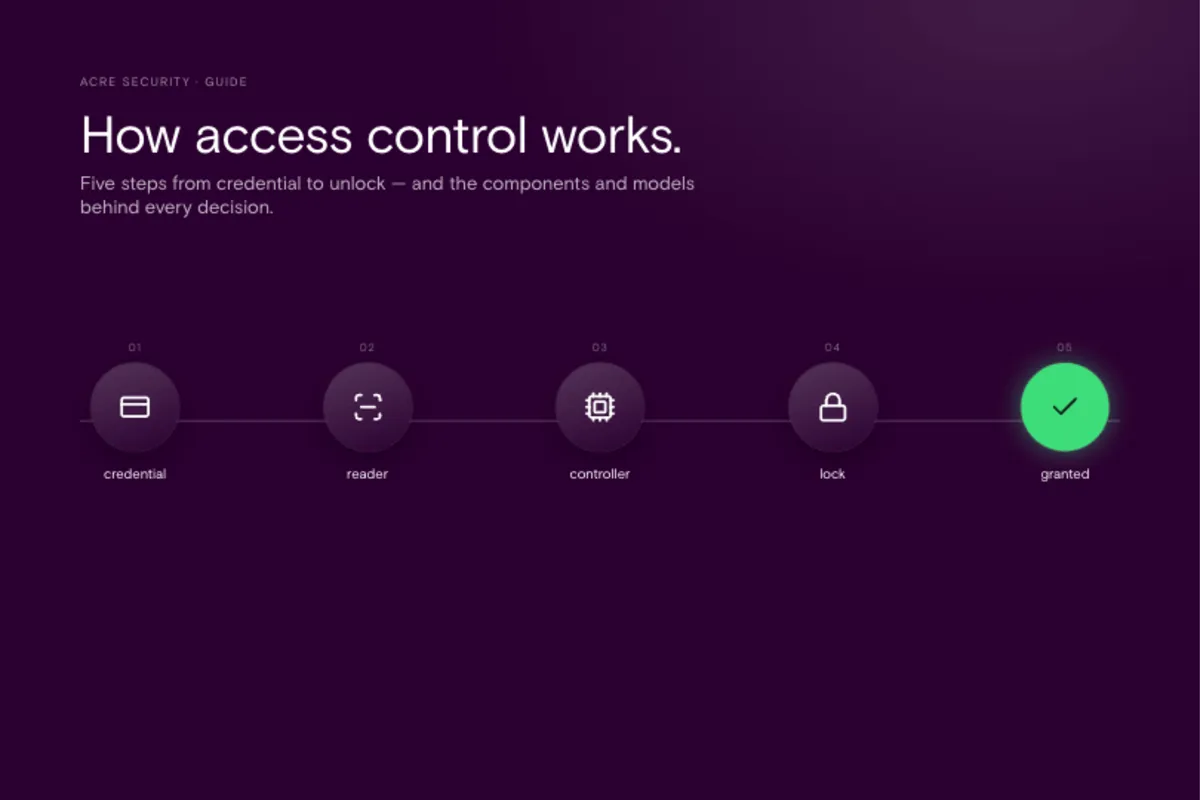
Acre installed card and proximity readers at every staff entrance across the hotel. Each reader requires staff to present an ID badge, and once scanned, the reader displays the cardholder's photo on a monitor in the security control room so the team can verify identity in real time. The system bars non-approved personnel and immediately alerts security, giving the team as much time as possible to respond to a potential breach. The result is a hotel access control system that gives The Ritz quick, easy staff access at every entrance while protecting guests from potential trespassers.
What makes this case study relevant beyond one landmark property is the pattern behind it: pair every staff key card with an identity check, treat every entrance as its own access point, and give security a way to see and respond to problems as they happen, not after a shift review. That pattern holds whether a hotel access control system is protecting one historic building or an entire portfolio of properties.
Read the full case study on Acre Security →
Hotel Access Control Built on Acre's Access Control Platforms
The Ritz London's deployment reflects the same on-premises architecture Acre offers today through ACTpro, and the same approach, card and proximity credentials, zone-based permissions, and real-time verification, scales to hotel access control systems of any size, whether a single landmark property or a multi-property portfolio.
ACTpro: On-Premises Hotel Access Control for Landmark and High-Security Properties
For hotels that need hotel access control to stay entirely on local infrastructure, whether for data residency reasons or because the building itself, like a heritage or Grade II listed property, can't accommodate a full network overhaul, ACTpro manages credentials, readers, and door hardware on-premises. It supports wired and Aperio wireless lock integration, which matters for older hotel buildings where running new cabling to every guest room door isn't practical or is restricted by heritage protections.
Acre Access Control and ACT365: Cloud-Managed Hotel Access Control Across Properties
Hotel groups managing more than one property benefit from centralizing hotel access control in the cloud. Acre Access Control and ACT365 give a security team visibility into staff and back-of-house access across every property from one dashboard, with real-time alerts when a door is forced, held open, or accessed outside its normal hours. Multi-site administration means a new property can be added to an existing hotel access control system rather than starting from a disconnected setup at every new location.
Guest Room Access Control With Smart Locks
Guest room doors carry their own set of expectations: guests want convenience, hotel security teams want an audit trail, and neither wants to deal with a lost physical key. Acre's ACTpro platform supports Aperio wireless smart locks, which connect guest room doors into the same hotel access control system managing staff entrances and back-of-house zones, without the cost or disruption of wiring every guest room individually. That means a lost key card can be deactivated instantly and reissued at the front desk, and every guest room access event is logged in the same system as every staff badge read.
Older key card systems, particularly magnetic stripe formats still found in many legacy hotel access control systems, are relatively easy to clone and offer little insight into who actually opened a door. Moving guest room doors onto smart locks tied into the same access control system as staff entrances closes that gap: a key card issued at check-in and deactivated at check-out behaves like any other credential on the property, tracked, time-limited, and revocable the moment it's no longer needed. Guest rooms, corridors, and elevators can all sit on the same smart lock and reader infrastructure, so a lost key card affects one guest's room rather than raising questions about the rest of the floor.
Mobile Key Access With Acre Wallet
Physical key cards get demagnetized, left in other jackets, or forgotten in a guest room after check-out. Acre Wallet issues mobile credentials over Bluetooth and NFC, protected by the guest's own phone biometrics, so a mobile accesss key can open a guest room door without a card at all. For hotel access control specifically, this also simplifies staff credentialing: rather than issuing and collecting physical badges for every new hire or seasonal worker, staff access can be granted and revoked instantly through a mobile credential tied to an individual, not a card that can be lost or passed along.
Zone-Based Security for Hotel Access Control
Not every door in a hotel needs the same level of security. A back-of-house corridor, a housekeeping storage room, an executive office, and a guest floor all carry different risk levels, and a hotel access control system should reflect that.
The Ritz London's deployment was built around exactly this requirement: different levels of security tied to pre-defined zones, so staff access matches their role rather than granting blanket access to the entire property. Acre's access control platforms manage this the same way, letting a security team assign zone-specific permissions by role, shift, or department, and adjust those permissions the moment a role changes.
Real-Time Monitoring and Verification for Hotel Access Control
A card reader that only unlocks a door isn't enough for a property the size of a major hotel. The verification step matters just as much: when a badge is scanned, security should be able to confirm the person presenting it is who the credential says they are.
That's the model Acre built for The Ritz London, where every staff badge scan displays the cardholder's photo in the security control room in real time, so an unfamiliar face on a valid-looking badge doesn't slip through unnoticed. Paired with instant alerts for denied access attempts, this kind of real-time verification turns a hotel access control system from a passive lock into an active line of defense.
Staff and Contractor Credentialing With Acre Identity
Hotels run on a mix of full-time staff, seasonal workers, contractors, and third-party vendors, all of whom need some level of access to a property without needing the same access as everyone else. Acre Identity sits above the access control system to unify how these different groups are welcomed, verified, credentialed, and managed across a hotel or hotel group, bridging access control with the kind of workflow automation that keeps a growing staff roster from turning into an access control liability.
Scaling Hotel Access Control Across Multiple Properties
A single boutique property and a global hotel group need very different starting points for hotel access control, but the same underlying system can serve both. Acre typically starts with a pilot at one property or even one wing of a building, proving that readers, zone permissions, and verification workflows perform as expected before scaling to the rest of a portfolio. For a hotel group planning expansion, whether that's more staff, more buildings, or more properties entirely, the same hotel access control system that started at a single landmark property scales without needing to be replaced.
Hotel Access Control From Check-In to Check-Out
A guest's relationship with a hotel's access control system starts the moment they check in and ends the moment they check out, and every point in between should stay just as secure as the staff entrances protecting the rest of the property.
At check-in, front desk staff issue a credential, whether a key card or a mobile key, scoped to that guest's room and length of stay. Through the stay, that credential works the same way any other credential on the access control system does: logged, time-bound, and tied to an individual guest rather than a generic room number. At check-out, the same credential is deactivated, closing the door, literally, on that guest's access before the next one arrives.
None of this requires Acre to connect directly into a hotel's property management system. Front desk staff manage credential issuance and deactivation the same way they always have, just through a hotel access control system that logs and revokes access far more reliably than a stack of physical keys ever could.
Choosing the Right Hotel Access Control System for Your Property
A single boutique hotel and a multi-property hotel group need different starting points, even though both are shopping for a hotel access control system built around the same core problem. A landmark or heritage property, like The Ritz London, tends to need the on-premises control and heritage-conscious installation that ACTpro and Aperio wireless locks provide, since running new cabling through a protected building isn't always possible. A newer build or a growing regional chain is often better served starting with Acre Access Control or ACT365, where remote administration and multi-site dashboards matter more than air-gapped, on-premises control.
Property size matters too. A boutique property protecting a handful of critical doors, the main staff entrance, a server room, an executive office, can start with Smart Controller and expand from there. A large property or hotel group with dozens of staff entrances, guest rooms, and back-of-house zones needs the full reader and credential range Acre offers from day one. Either way, the right hotel access control system is the one that can grow with the property rather than needing to be replaced the next time staff levels or room counts increase.
Hotel groups comparing hotel access control systems across a portfolio of different building ages and sizes don't have to standardize on a single deployment model. A group can run ACTpro at a heritage flagship property and Acre Access Control or ACT365 at newer builds, while still reporting into consistent policies for staff credentialing and guest room access across every property in the portfolio.
Compliance Considerations for Hotel Access Control
Guest and staff access data is subject to the same compliance scope as any other data managed by the access control system running it. Acre's data protection posture aligns with GDPR across the platforms handling hotel credentials. SOC 2 is confirmed specifically for Acre's cloud access control offerings, meaning ACT365 and Acre Access Control, not the on-premises platforms. ISO 27001 certification applies to specific parts of Acre's portfolio, not as a blanket guarantee across every product, so scope should be confirmed for your specific deployment.
Secure Every Entrance, Not Just the Lobby
If your hotel's staff entrances run on a shared code or a key card system with no record of who used it, then the fix isn't a stronger lock at the back door, it's bringing every entrance, staff and guest alike, into one hotel access control system.
Talk to the Acre team to find the right hotel access control setup for your property, whether that means on-premises card and proximity readers like The Ritz London, Aperio smart locks for guest rooms, or mobile key access through Acre Wallet.
If you're weighing the cost of upgrading staff entrance security against a full hotel access control system, then run the numbers with Acre's TCO calculator before you decide. Run the TCO Calculator here

.webp)
.jpg)