
Prison Visitor Management System: Secure Access for Correctional Facilities
.webp)
Managing visitor access at a correctional facility is one of the most complex security challenges in physical security. Every approved visitor entering the visiting room represents a potential security risk if the underlying process is unreliable. Paper-based logs, manual ID checks, and disconnected visiting lists create gaps that experienced security personnel cannot fully close on their own.
Organizations that handle high-stakes visitor management at scale trust Acre Security to close those gaps. Acre's Enterprise Visitor Management platform is deployed by Google, Analog Devices, a major Global Financial Services Company, and a leading German Supermarket Chain across 14+ UK sites. If your correctional facility needs a visitor management system that connects directly to access control, automates background checks, and delivers auditable records of every visit, the same platform is built for that environment.
Note: If your correctional facility is managing visitor registration manually, every visit is a gap in your security record. Acre's Enterprise Visitor Management automates screening, enforces access control at every entry point, and gives you a complete audit trail from approval to exit. Talk to the Acre team to see how it works in a correctional environment.
Why Standard Visitor Management Fails in a Prison Environment
Most commercial visitor management software is designed for corporate lobbies, not correctional facilities. The result is a system that handles visitor registration but cannot enforce the strict control that a prison facility demands. Approved visitors go through manual verification. The visiting list is checked against paper records. Security personnel rely on tribal knowledge rather than automated controls.
The operational challenges compound quickly. Processing times slow when volumes increase. Visitor data is recorded inconsistently, making compliance audits painful. And when a security breach occurs, there is no reliable audit trail to reconstruct what happened, who was approved, and who authorized the visit.
A purpose-configured prison visitor management system solves each of these problems systematically.
How Acre's Enterprise Visitor Management Controls the Visitation Process
Acre's Enterprise Visitor Management (EVM) platform is a cloud-based visitor management system designed for organizations that cannot afford ambiguity at the point of entry. For correctional facilities, it replaces manual processes with automated, auditable workflows that give security personnel full visibility over every approved visitor, every visit, and every movement through the facility.
Acre's client portfolio of brands like Google, make them a top visitor management solution.
Pre-Registration and Visiting List Management
Before a visitor arrives, EVM allows facilities to configure the approved visitors list digitally. Visitors can be pre-registered by staff or through digital invite workflows. Each visitor profile captures the information needed for accurate identification: government-issued ID details, relationship to the inmate, and any conditions attached to their visitation approval.
Processing time for visiting applications is a known pain point in prison systems. EVM accelerates this by centralizing visitor data and giving administrators a single interface to approve, modify, or revoke access without manual paperwork delays.
Automated Background Checks and Watchlist Screening
Accurate identification at arrival is not sufficient if the underlying screening process is unreliable. Acre's platform supports automated background checks and watchlist screening at the point of check-in, cross-referencing visitor IDs against relevant databases to flag potential security risks before a visitor is cleared into the visiting room.
Deny-entry rules can be configured to block only authorized individuals from proceeding past the lobby. This removes human error from a decision that should be governed by verified data, not manual judgment under pressure. The system supports driver's licenses, passports, and government-issued IDs for visitor identification, ensuring accurate identification across all visitor types.
Self-Service Check-In and Reduced Processing Times
EVM supports self-service check-in on kiosks or tablets, significantly reducing processing times during peak visitation windows. Returning visitors who are already on the approved visitors list can be checked in rapidly without requiring security personnel to manually search records.
New visitor enrollment is handled at the kiosk, with ID scanning capturing visitor data directly into the system. Host notifications and approval workflows can be configured so that the right staff member is alerted the moment a visitor clears the desk, keeping the visitation process moving without sacrificing oversight.
Access Control Integration: Restricting Visitor Movements to Authorized Zones
A visitor management system that does not connect to physical access control is incomplete in a correctional facility context. Logging a visit is not the same as controlling where that visitor goes. Acre's EVM integrates directly with Acre's access control platforms, including Acre Access Control (cloud), ACT365, ACTpro, and DNA Fusion, creating a unified system that governs visitor movements from entry to exit.
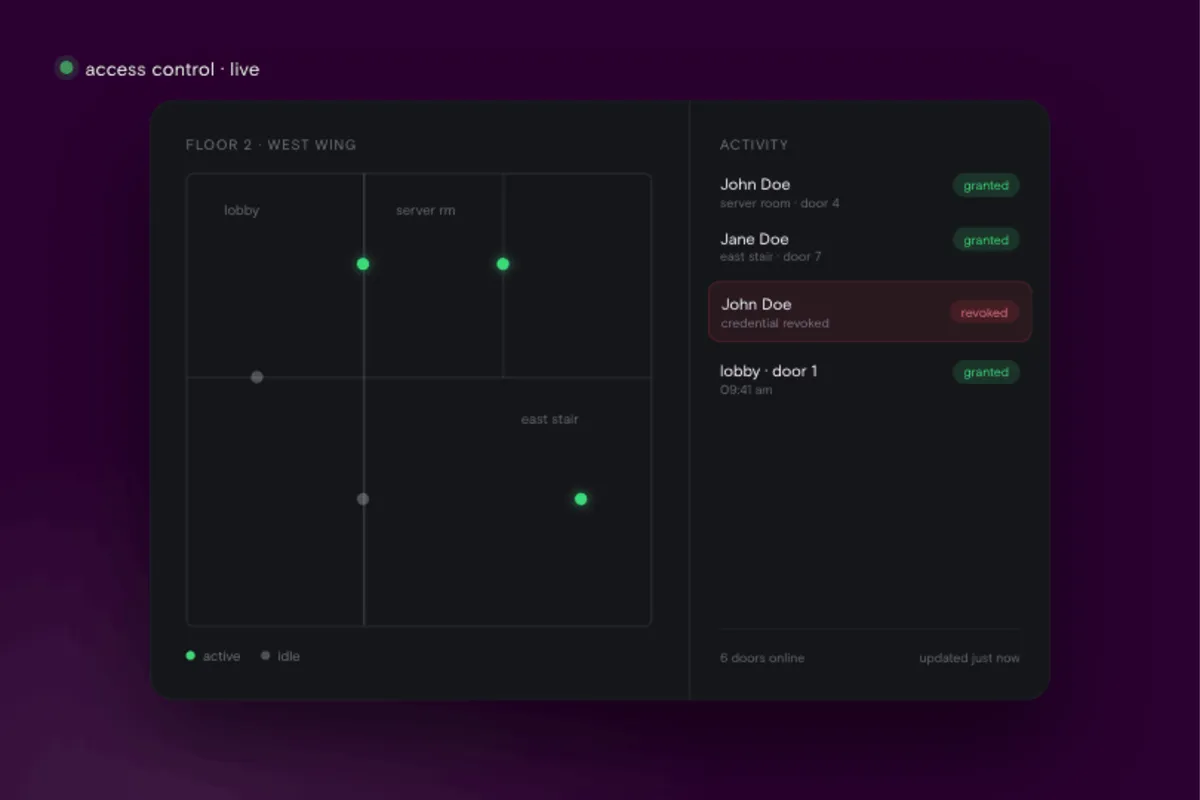
This integration is one of Acre's core differentiators. When a visitor is checked in, the system can generate a time-bound badge, QR code, or temporary credential that restricts that visitor to specific areas. Only authorized individuals are permitted to enter sensitive areas beyond the visiting room. If a visitor attempts to move outside their approved zone, the system flags it in real time.
For correctional facilities managing multiple zones, this capability ensures that visitor movements are tracked continuously and that security personnel receive immediate alerts if a visitor deviates from their approved path.
Video Visit Capabilities and Managing Remote Visitation
Many modern prison facilities supplement in-person visits with video visit options, reducing the operational burden of managing approved visitors in a physical visiting room while maintaining meaningful contact between inmates and their immediate family members.
Video visit functionality expands the scope of visitor management beyond the physical facility. A visitor management system that captures visitor registration, maintains the visiting list, and connects video visit scheduling to the same audit trail gives administrators a complete record of all contact, regardless of format.
Acre's platform supports all types of visitor management like flexible check-in flows that can be adapted to different visitor types, including those participating in video visits, ensuring that the same security protocols apply whether the visit is conducted in person or remotely.
Data Security, Compliance, and Audit Readiness with Acre EVM
Prison facilities operate under strict legal and regulatory standards governing sensitive data. Visitor data, including personal identification, visiting history, and access logs, constitutes sensitive information that must be protected and available for audit on demand.
Acre's EVM platform replaces paper logs with complete digital audit trails. Every visit is recorded with timestamps, visitor identification details, and access events. Reports can be generated across any date range, filtered by visitor type, inmate, or location, giving compliance teams the documentation they need without manual reconstruction.
Advanced Encryption and Data Protection
Visitor data in the EVM platform is protected through advanced encryption protocols. The platform's cloud infrastructure supports deployment on major cloud providers with enterprise-grade data security standards. For facilities requiring total local control over their data, on-premises deployment options are available, keeping sensitive data entirely within the organization's own environment.
This deployment flexibility is a key differentiator for Acre. Correctional facilities can choose cloud deployment for scalability and remote management, transition with on-premises deployment for data sovereignty, or a hybrid configuration that balances both. No rip-and-replace of existing systems is required. Acre's platform integrates with the infrastructure already in place.
Compliance Workflows Built Into the Visitation Process
EVM's customizable check-in flows allow facilities to build compliance steps directly into the visitor registration process. A visitor can be required to acknowledge specific policies, confirm dress code requirements, or complete a consent step before they are cleared. These workflow confirmations are captured in the visitor's digital record, providing documentation that would otherwise require separate manual tracking.
Key capabilities
- Digital check-in and check-out records: Every visitor’s entry and exit is logged electronically, creating an immutable audit trail.
- Real-time tracking of visitor movements: The system monitors and records visitor locations within the facility, preventing unauthorized movement
- Identity verification and watchlist screening: Visitors are screened against internal and external watchlists, with multi-factor or biometric ID checks to prevent impersonation.
- Integration with access control systems: Visitor credentials are linked to physical access points, restricting movement to approved areas only.
- Reporting and audit trails: Comprehensive reports support compliance audits and incident investigations
- Alerts for security incidents: Automated notifications are triggered for policy violations or suspicious behavior
- Scalability for high-volume environments: The system can handle large numbers of visitors without performance issues.
- Support for emergency lockdown procedures: Instant roll calls and evacuation lists are available at the click of a button.
By digitizing and automating the visitor process, prisons gain operational efficiency and a powerful tool for risk mitigation and regulatory compliance. The result is a safer, more accountable environment for staff, inmates, and visitors.
Key Features of Acre's Prison Visitor Management System
Acre's Enterprise Visitor Management platform delivers the capabilities that a correctional facility's unique security environment demands. The following key features distinguish it from general-purpose visitor management software:
- Approved visitor pre-registration: Digital management of the visiting list with configurable approval workflows.
- Automated background checks: Real-time screening against watchlists and databases at the point of arrival.
- Self-service kiosk check-in: Reduces processing times and frees security personnel for higher-value tasks.
- Access control integration: Direct connection to Acre's AC platforms governs visitor movements through the facility.
- Time-bound credentials: Badges, QR codes, and temporary access cards restrict visitors to only authorized zones.
- Real-time alerts: Security personnel receive instant notifications for flagged visitors, denied entries, or zone violations.
- Complete digital audit trails: Every visit is recorded and retrievable for compliance and investigations.
- Flexible deployment: Cloud, on-premises, or hybrid, with no forced rip-and-replace of existing systems.
- 125+ workplace integrations: Connects with Outlook, Teams, Google Workspace, and existing security platforms.
.png)
Deploying a Visitor Management System in a New or Existing Correctional Facility
Implementing a visitor management system in a correctional facility requires careful planning, particularly when integrating with existing systems or commissioning a new facility from the ground up. Acre's deployment approach is designed to minimize disruption and reduce the risk of implementation failures during transition.
Integration with Existing Infrastructure
Many correctional facilities operate a combination of legacy access control hardware and newer digital systems. Acre's open architecture and API-first design mean that EVM connects with existing infrastructure without requiring a complete overhaul. Acre's Acre Bridge product connects on-premises security management systems to Acre's cloud platform, enabling a phased migration that keeps existing doors and readers operational throughout the transition.
This approach eliminates the operational risk associated with a hard cutover. Security personnel continue working with familiar systems while the new visitor management platform comes online in parallel. Pilot deployments can validate the configuration before facility-wide rollout.
Configuration for Emergency Situations and Lockdowns
A visitor management system in a prison facility must perform reliably in emergency situations. Acre's platform supports system-wide lockdown commands that can be triggered from the management interface, restricting all visitor movements instantly across the facility. Real-time monitoring tracks all active visitors during the event, giving security personnel an accurate picture of who is inside and where they are located.
This capability is directly relevant to the unique security environment of correctional facilities, where the ability to account for every person in the building during an emergency is a critical operational requirement.
Security protocols for prison visitor systems
Security is the foundation of any visitor management system in a correctional facility. The software must operate within a secure infrastructure, using advanced encryption to protect sensitive data both in transit and at rest. This ensures that visitor information, access logs, and incident reports remain confidential and tamper-proof.
Integration with surveillance and access control systems is critical. By linking visitor management software with existing security infrastructure, facilities can monitor visitor movements in real time and restrict access to sensitive areas. This layered approach deters unauthorized access and provides a comprehensive view of all activity within the facility.
User authentication protocols are also essential. Role-based access controls ensure that only authorized personnel can view or modify visitor records, reducing the risk of internal breaches. Continuous monitoring and audit logging further enhance security by providing a clear record of all system activity.
Biometric and watchlist screening functionalities add another layer of protection. Systems that incorporate fingerprint or facial recognition can prevent individuals on restricted lists from gaining entry, even if they attempt to use false identification. This capability is particularly valuable in custodial environments, where the risk of impersonation or collusion is high.
Ultimately, the security protocols embedded in visitor management software protect the facility from external threats and provide a defensible record of compliance with regulatory requirements. By adopting a multi-layered security approach, correctional facilities can mitigate risks and maintain control over every aspect of the visitation process.
How Acre's visitor management works in practice
The operation of a prison visitor management system begins before a visitor arrives. The process typically starts with pre-registration, where visitors submit their details and identification online. This information is screened against restricted lists and watchlists, allowing security staff to flag potential risks in advance.
Upon arrival, visitors are greeted by security personnel and directed to a check-in kiosk or desk. Their identity is verified, often using biometric authentication or multi-factor ID checks. The system confirms their appointment, prints a visitor badge, and logs their entry. This digital record replaces the traditional sign-in book, providing a tamper-proof audit trail.
During the visit, the system tracks the visitor’s movements within the facility. Access to specific areas is controlled through integration with physical access systems, ensuring that visitors can only enter approved zones. Security staff monitor visitor activity in real time, with automated alerts for any deviations from approved behavior.
At the end of the visit, the check-out process is streamlined. Visitors return their badges, and the system logs their exit. All records are stored electronically, supporting both operational oversight and compliance reporting. In the event of an incident or audit, administrators can quickly retrieve detailed logs of every visit.
The transition from manual to digital visitor management delivers significant operational benefits. Administrative workloads are reduced, processing times are shortened, and the risk of errors or omissions is minimized. Most importantly, the facility gains a powerful tool for maintaining security and demonstrating compliance.
Why Enterprise Organizations Choose Acre for Visitor Management
Acre Security is trusted by organizations that operate at a scale where visitor management failures have real consequences. Google selected Acre's platform for enterprise visitor management at a global technology headquarters, achieving measurable cost savings and administrative reduction through cloud VM combined with deep access control integration. Analog Devices and a major Global Financial Services Company rely on the same platform for secure, compliant visitor management across their facilities.
A leading German Supermarket Chain expanded Acre's visitor management deployment to more than 14 UK sites after an initial pilot, demonstrating the platform's ability to scale from a single location to a multi-site estate without architectural changes.
These outcomes reflect what Acre's platform is designed to deliver: reduced administrative burden, faster visitation processing, tighter access control, and audit-ready compliance documentation. For a correctional facility evaluating a prison visitor management system, this track record with demanding enterprise clients is the most relevant indicator of operational reliability.
Comparing visitor management solutions for correctional facilities
Correctional facilities have several approaches to visitor management, each offering different trade-offs in flexibility, security depth, integration capability, and long-term scalability. The most suitable option depends on the facility’s size, risk profile, regulatory environment, and existing security infrastructure.
Rather than viewing these options as mutually exclusive, many correctional facilities are moving toward platforms that combine enterprise flexibility with corrections-specific controls. Solutions that integrate visitor management directly with identity and access control systems provide stronger enforcement, better situational awareness, and more defensible compliance outcomes.
The right solution delivers robust security and compliance while remaining adaptable to operational realities, future growth, and evolving regulatory demands.
Acre security and prison visitor management
Acre Security provides enterprise visitor management and identity solutions suitable for high-security environments, including correctional facilities. Its platforms support controlled visitor workflows, centralized oversight, and integration with access control and physical security systems.
Acre’s visitor management operates within a broader identity and access control ecosystem rather than as a standalone tool. This enables stronger enforcement of visitation policies, improved auditability, and better alignment with compliance requirements.
Core Capabilities
- Core capabilities
- Digital visitor registration and check-in/check-out
- Centralized dashboards and reporting
- Pre-registration and identity data capture
- Integration with access control and physical security
- Compliance-ready reporting and audit trails
Platform overview
Visitor management is delivered through Acre Visitor Management and FAST-PASS, operating within the Acre Identity ecosystem to support automated workflows, identity verification, and auditable records.
Value for correctional environments
- Security: Greater visibility and access control
- Compliance: Audit-ready visitor records
- Operations: Reduced manual processing
Implementation best practices
Deploying a prison visitor management system requires careful planning and execution. The first step is stakeholder engagement, bringing together security staff, IT teams, administrators, and compliance officers to define requirements and set clear objectives.
Integration with existing systems is another critical consideration. The visitor management software must work seamlessly with access control, surveillance, and other security infrastructure.
Training for security staff is paramount. Comprehensive training programs should cover system operation, security protocols, incident response, and compliance requirements.
A phased implementation approach allows for testing and refinement before full-scale deployment. Feedback from staff and visitors can be used to optimize workflows.
Data governance policies must be established to ensure that visitor information is handled securely and in compliance with legal requirements. Ongoing monitoring and regular audits help maintain compliance and identify areas for improvement.
Successful implementation is not a one-time event but an ongoing process.
Compliance considerations: privacy, legal, and corrections standards
Compliance is not just a regulatory checkbox for correctional facilities; it is a fundamental requirement that underpins both security and operational integrity. Visitor management software must support a wide range of legal and policy frameworks, ensuring that every aspect of the visitation process is auditable and defensible.
Key compliance areas
- Data protection laws (GDPR and regional equivalents): Ensuring that visitor data is collected, stored, and processed in accordance with privacy regulations.
- Corrections-specific visitation policy adherence: Enforcing facility-specific rules regarding who can visit, when, and under what conditions.
- Records retention policies: Maintaining visitor logs and related documentation for mandated periods, with secure deletion protocols.
- Audit and reporting obligations: Providing comprehensive reports for internal and external audits, including incident logs and access records.
- Accessibility requirements: Ensuring that the system is usable by individuals with disabilities, in compliance with relevant standards.
- Identity verification compliance: Implementing processes that meet legal requirements for verifying visitor identities.
- Visitor classification and credential management: Differentiating between visitor types and assigning appropriate access rights.
- Secure data handling and encryption: Protecting sensitive information through robust encryption and secure storage.
- Chain of custody for records: Maintaining a clear, auditable trail of all actions taken on visitor records.
- Inter-agency reporting standards: Supporting data sharing and reporting requirements for coordination with law enforcement and other agencies.
Failure to adhere to these standards can result in regulatory penalties, reputational damage, and increased risk of security incidents. By embedding compliance into the design and operation of visitor management software, correctional facilities can demonstrate due diligence and maintain the trust of stakeholders.
Conclusion: the future of prison visitor management
Digital visitor management has become a foundational component of modern corrections security and compliance. By replacing manual processes with automated, auditable systems, correctional facilities gain operational efficiency and a powerful tool for risk mitigation and regulatory adherence.
The future of prison visitor management lies in continued innovation, including biometric authentication, advanced analytics, and seamless integration with broader security ecosystems.
Correctional administrators, security directors, and compliance officers should view digital visitor management not as a luxury but as an essential element of a secure, accountable, and future-ready facility.
Speak with the security experts at Acre to learn how enterprise visitor management can support secure, compliant correctional environments.

.webp)