Time-Based Access Control: Give Every User the Right Access at the Right Time with Acre
.webp)
Security teams rarely lose sleep over access control in the abstract. They lose sleep over the contractor badge that still opens the server room six months after the project ended, the after-hours access request nobody remembers approving, and the audit that turns up a dozen accounts with standing access to critical systems. Time-based access control (TBAC) closes those gaps by tying every access permission to a defined period, so user access expires on its own instead of depending on someone remembering to revoke it.
If your current access control models rely on manual deprovisioning or a spreadsheet to track who can go where and when, you are carrying risk that time-based access control was built to remove. Acre builds time-based access management into its access control platforms as a core capability, not an add-on project, so your IT and security teams can configure time-based rules once and trust the system to enforce them automatically.
Note: If your access permissions are still managed manually or your legacy system can't enforce access schedules on its own, that gap is quietly costing you audit hours and creating windows for unauthorized access. Talk to the Acre team, and we'll map out exactly how time-based access control would work across your sites, whether you're cloud-first, on-premises, or somewhere in between. You'll walk away with a clear path to automatic revocation and centralized access management, at whatever pace fits your operation.
Why Time-Based Access Control Belongs in Your Access Control Strategy Now
Insider threats, third party access, and remote access all expand the attack surface security professionals have to manage. Restricting access to specific hours and specific tasks is one of the most effective controls available, and one of the least disruptive to roll out, because it works with the user roles and access policies you already have in place instead of replacing them.
Time-based access control shows up across nearly every regulated and high-security environment:
- A global bank restricts access to financial systems after business hours.
- Contractor access is limited to the exact duration of the project, then automatically revoked.
- Healthcare institutions limit access to patient records outside office hours to protect sensitive data.
- Database administrators access production systems only when maintenance is scheduled, on a just-in-time basis.
Acre's access control software builds these access schedules directly into the platform, so you are not choosing between enhanced security and operational efficiency.
Learn more: What is Access Control?
How Acre's Access Control Platforms Enforce Time-Based Access Control
Whether your organization runs cloud-first, keeps critical systems on-premises, or manages a hybrid of both, Acre has a platform built to enforce time-based access control without forcing a rip-and-replace of your existing infrastructure. Let's go over all our access control solutions.
Acre Access Control: Cloud-Native Time-Based Rules at Enterprise Scale
Acre Access Control is Acre's flagship cloud-native platform, built for organizations that need centralized access management across many sites. It supports mobile and biometric credentials, real-time alerts, and analytics dashboards, so security teams can configure access schedules by user group, monitor access events as they happen, and adjust access permissions from a single console instead of chasing changes site by site.
ACT365: Global Cloud Access Control for Distributed Teams
ACT365 is Acre's cloud access control platform for organizations that need remote management across multiple buildings. Its open API connects to Time and Attendance and workforce systems, which means time-based access rules can align with shift schedules and HR data instead of living in a separate system that IT has to reconcile manually.
Access It! and DNA Fusion: On-Premises Time-Based Access Control for Sovereign Environments
For organizations that require local infrastructure, air-gapped environments, or data residency within their own network, Acre offers two on-premises platforms. Access It! is Acre's flagship on-premises access control software, built on Mercury hardware with an open architecture that supports biometric readers and remote administration. DNA Fusion is designed for organizations that need to unify access control with video, intrusion, and audio management in a single system. Both platforms support the same time-based access management principles as Acre's cloud products, configured and enforced entirely within your own infrastructure.
ACTpro: Time-Bound Access for Government and High-Security Sites
ACTpro is built for government, heritage, and other network-isolated sites where sovereignty and control access requirements make cloud deployment impractical. It supports wired and wireless lock integration at scale, so time-based access control can be enforced across hundreds of doors without depending on an outside network connection.
Smart Controller: Time-Based Access Control for SMB Budgets
Not every organization needs enterprise-scale infrastructure to benefit from time-based access control. Smart Controller is Acre's cost-optimized hardware that connects natively to Acre's cloud access control platform, bringing access schedules, automatic revocation, and centralized access management to organizations protecting a handful of critical doors, with room to expand as they grow.
Acre Wallet: Mobile Credentials That Respect Every Access Window
Acre Wallet delivers mobile credentials through the Apple, Google, and Samsung Wallet apps, with BLE and NFC tap-to-enter and biometric authentication at the device level. Because Acre Wallet works across Acre's full platform portfolio, a time-limited access grant configured in Acre Access Control, ACT365, or an on-premises platform applies the moment a credential is issued and disappears the moment the specified time window closes, no physical badge to collect.
Key Features Time-Based Access Control Software Needs
Not all access control models handle time-bound rules the same way. When you are evaluating time-based access control software, or auditing what you already have, look for these capabilities:
- Access schedules configurable by user group, not just by individual, so onboarding a shift or a project team is a single action.
- Automatic revocation at the end of a defined period, without a manual offboarding step.
- Identity governance integration, so time-based rules stay aligned with HR and IT systems as roles change.
- Access logs with timestamps for every access event, to support audit compliance and investigations.
- Multi-factor authentication on administrative and privileged accounts.
- Centralized access management across sites, so access policies are consistent instead of drifting site by site.
Acre's access control platforms are built around these features, which is why security teams use them to move from persistent, standing access to access that is granted for a defined period and closed automatically when that period ends.
Time-Based Access Control Use Cases Across Industries
Enterprises across sectors already rely on Acre's access control platforms to manage user access across distributed portfolios. Palo Alto Networks and Coca-Cola Hellenic both run Acre's access control platforms across their sites, and Hydro Ottawa uses Acre to secure critical infrastructure, the same centralized access management foundation that a time-based access control rollout builds on. A global media company with more than 150 sites uses Acre to keep access policies consistent across every location it operates, rather than managing schedules and permissions site by site.
These are general access control deployments, not case studies specific to time-based rules, but they demonstrate the scale and reliability of the platforms enforcing time-based access control described above. A financial services organization managing dozens of branch locations faces the same underlying problem as a university managing residence halls or a manufacturer managing shift-based plant floors: user access needs to expire on a schedule, not depend on someone remembering to revoke it, and it needs to do so consistently across every site rather than one location at a time.
The common thread across these deployments is centralized access management. Whether the priority is restricting access to a data center after business hours, limiting user access for seasonal staff, or granting temporary access to vendors and contractors, the underlying access control models are the same. What changes is how each organization configures its access schedules, and Acre's platforms are built to make that configuration a matter of policy, not custom engineering.
RBAC vs. ABAC vs. Time-Based Access Control: Choosing the Right Model
Role-based access control (RBAC) ties access permissions to a job role: a person's title determines their access rights. Attribute-based access control (ABAC) goes further, evaluating multiple attributes, including role, location, time, and context, together to make each access decision. Time-based access control is not a competing model so much as a layer that can sit on top of either one, adding a specific hours or specified time interval condition to an RBAC or ABAC decision.
Most security teams reference three practical models when they talk about access control models: role-based access control, attribute-based access control, and time-based access control. In practice, the strongest access policies combine all three, using roles to set the baseline, attributes to add context, and time to enforce least privilege automatically.
Just-in-Time Access vs. Privileged Access Management
Just-in-time (JIT) access grants access only for the duration of a specific task, then revokes it automatically once that task is complete. Privileged access management (PAM) is broader: it governs standing privileged accounts with controls like session monitoring, approval workflows, and multi-factor authentication, whether or not that access is time-limited. Time-based access control is the mechanism that makes just-in-time access possible, and it strengthens privileged access management by ensuring privileged sessions expire instead of persisting indefinitely.
Common Time-Based Access Control Challenges, and How Acre Removes Them
Time-based access control is not difficult in concept, but it introduces real coordination challenges at scale:
- Misconfigured rules can block necessary access and disrupt workflows if hours or user groups are set incorrectly.
- Managing access policies across multiple teams and systems adds complexity without a centralized console.
- Large enterprises face scalability issues when time-based rules are managed manually across hundreds of doors.
- Without automated deprovisioning, organizations risk privilege creep as temporary access quietly becomes permanent.
Acre addresses these challenges with centralized access management across every platform in its portfolio, prebuilt access schedule templates, and system clock synchronization built into the deployment, so security teams spend less time troubleshooting rules and more time relying on them. Because access control lists and access policies are managed from one console rather than site by site, changes to user roles or access rights propagate consistently, which reduces the coordination burden that typically slows down a time-based access control rollout at large enterprises.
Any Deployment, Any Pace: Modernizing Legacy Access Control With Acre
You do not need to have a modern access control system in place already to benefit from time-based access control. Acre works with organizations wherever they are today, whether that means a fully physical, on-premises deployment, a cloud-first environment, or a hybrid of the two. If your legacy access control system cannot support access schedules, automatic revocation, or centralized access management, Acre's team will help you map a path forward, at your pace, whether that is a phased migration one site at a time or a single pilot deployment before a wider rollout.
That flexibility is deliberate. Security teams do not have the budget or the appetite to rip out working infrastructure overnight, and Acre's portfolio, spanning cloud platforms like Acre Access Control and ACT365, on-premises platforms like Access It!, DNA Fusion, and ACTpro, and SMB-focused hardware like Smart Controller, is built so you can modernize on a timeline that matches your operations, not the other way around.
How Time-Based Access Control Works
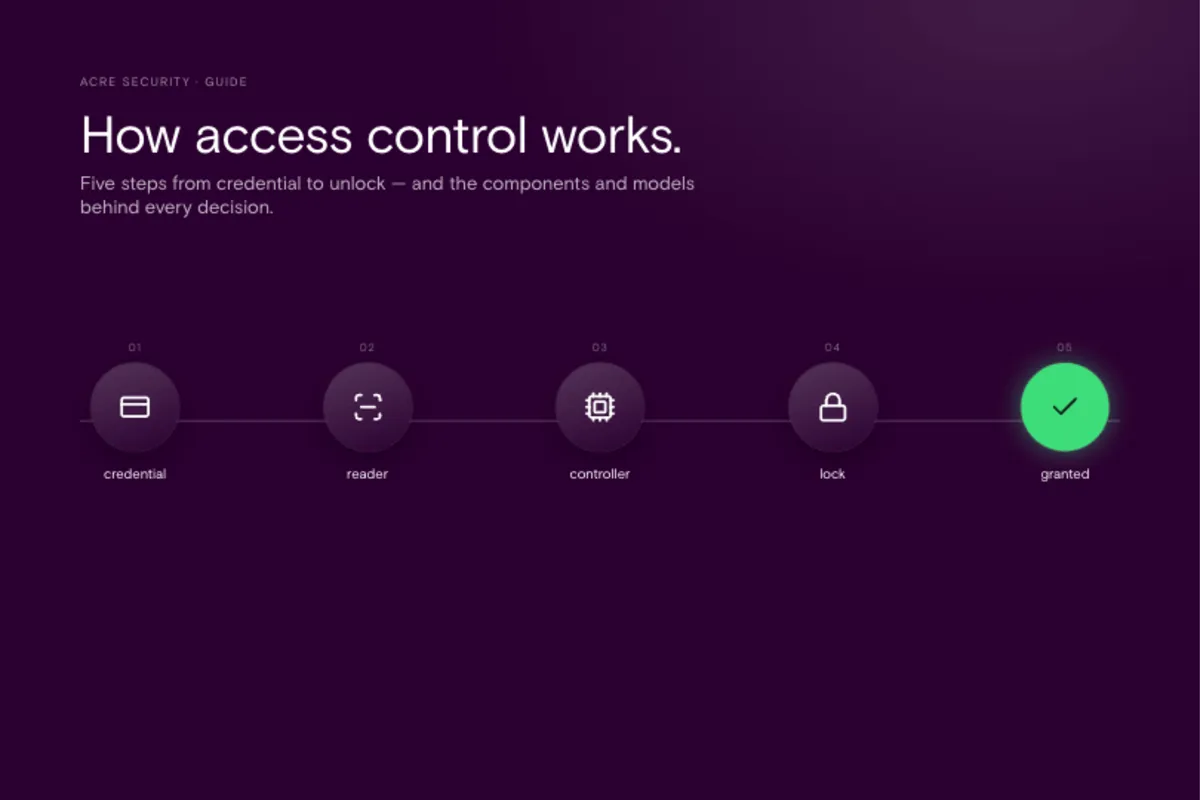
TBAC is a gamechanger because of two factors: automation and precision. Estimates put the percentage of data breaches due to human error at anything between 74% and a staggering 95%. TBAC removes human error from access management by following a simple workflow:
- Access schedules and permissions: Administrators configure access schedules in the central access control system. These schedules can be based on specific hours, days of the week, or even calendar dates. For example, your standard business hours or cleaning crew access.
- Approval and integration: These time-based permissions are then integrated with an account holder's identity and assigned role – or an emergency access policy. The system automatically activates an account holder’s permissions during the approved time windows. This ensures that their credential (e.g. keycard, fob, or mobile ID) only grants them access when the policy allows it.
- Automatic revocation: When the pre-defined period ends, the system automatically revokes access rights.
- Real-time monitoring: Every access event, whether granted or denied, is logged. This continuous monitoring provides a detailed, auditable trail of all access activity for security and compliance.
Time-Based vs. Task-Based And Role-Based Access Control
TBAC is most effective as a component of a layered security strategy that includes other access control models. In the same way that TBAC grants access based on a schedule, Role-Based Access Control (RBAC) grants access based on an account holder's role or job function. Similarly, Resource/Task-Based Access Control (RTBAC or Just-in-Time (JIT)), grants temporary access for a specific task or a short, defined duration.
An optimized security system combines these models. For example, you might use RBAC to grant a server administrator access to the data center, with TBAC restricting that access to standard business hours. Or, you could use JIT access to grant a contractor entry to a secure facility for a specific window of time to complete a task.
By layering access control models, you create a system that is both maximally secure and flexible.
See Time-Based Access Control Running on Your Own Sites
Whether you are replacing a legacy system, adding time-based rules to an existing deployment, or starting from scratch, Acre's team can show you exactly how access schedules, automatic revocation, and centralized access management would work across your sites.
Ready to see it in action? Talk to the Acre team to walk through your current setup and where time-based access control fits.
Want to see the cost impact first? Run the numbers with Acre's TCO Calculator before you talk to anyone.
How Acre Security Delivers Secure Time-Based Access Control Solutions
Acre Security understands the need for secure, schedule-driven access. We focus on simplifying time-based access with powerful platforms that are built to handle both granular policies and large-scale employee rosters and access points.
Our access control solutions cseamlessly integrate with your existing systems, new and old. Your TBAC system is scalable and flexible to your unique needs, and everything can be managed from a single, user-friendly platform.
We have a team of experts on hand to help you with implementation and maintenance. It’s our job and our pleasure to help you build a system that protects your organization.
Simply controlling who has access is no longer enough. The next-generation approach is to also control when that access is granted. Time-based access control provides a smart, automated layer of defense that removes manual effort and human error from access management.
TBAC strengthens your security, mitigates against insider threats, and streamlines operations in busy environments. It’s an essential part of a layered strategy that will keep your security protocols always working, even when you're not.
Ready to strengthen your defenses? Contact us today.
Frequently Asked Questions About Time-Based Access Control
What is time-based access control?
Time-based access control (TBAC) is an access control model that grants user access for a defined period and automatically revokes it once that period ends, rather than leaving access permissions in place indefinitely.
What's the difference between RBAC and ABAC?
Role-based access control (RBAC) grants access based on a person's job role. Attribute-based access control (ABAC) evaluates multiple attributes, such as role, location, time, and context, together to make each individual access decision, which makes it better suited to complex or dynamic access requirements.
What are the three types of access control?
Security teams most often reference role-based access control (RBAC), attribute-based access control (ABAC), and time-based access control (TBAC) as the three practical models guiding modern access decisions, frequently used together rather than in isolation.
What is the difference between JIT and PAM?
Just-in-time (JIT) access grants temporary access for the duration of a specific task and revokes it automatically afterward. Privileged access management (PAM) is the broader discipline of governing privileged accounts, including monitoring, approvals, and authentication controls, independent of whether that access is time-limited.
.webp)
.webp)
.jpg)