
Genetec vs Verkada vs Acre: Which Security Platform Wins — And Why Acre Changes the Conversation
.webp)
Most enterprises don't realize they're locked into a security system until they try to change it. You've invested in hardware, trained staff, and built workflows around a platform — and then you try to scale, swap a component, or bring in a new site. Suddenly, what felt like a solid foundation reveals its limits.
This is the lock-in problem. And it's reshaping how forward-thinking organizations evaluate every video surveillance and access control decision they make.
The Genetec vs Verkada debate dominates many buying conversations. Both are established platforms with real deployments at scale.
But for enterprises that need flexibility, open architecture, and a migration path that doesn't punish them for modernizing, there's a third option that's gaining serious traction: Acre Security.
This article breaks down all three — what each platform does well, where each falls short, and what to ask before you commit. We'll start with the organization we know best--our own.
Note: If you want to avoid Genetec's complexity from slowing your team down… If Verkada's subscription model will eat into your budget device by device… If you're done trading flexibility for functionality…Then there's a better way to protect your people, premises, and data. Book a free call with the team and see the difference firsthand.
Acre Security: Built for Enterprises That Refuse to Be Boxed In
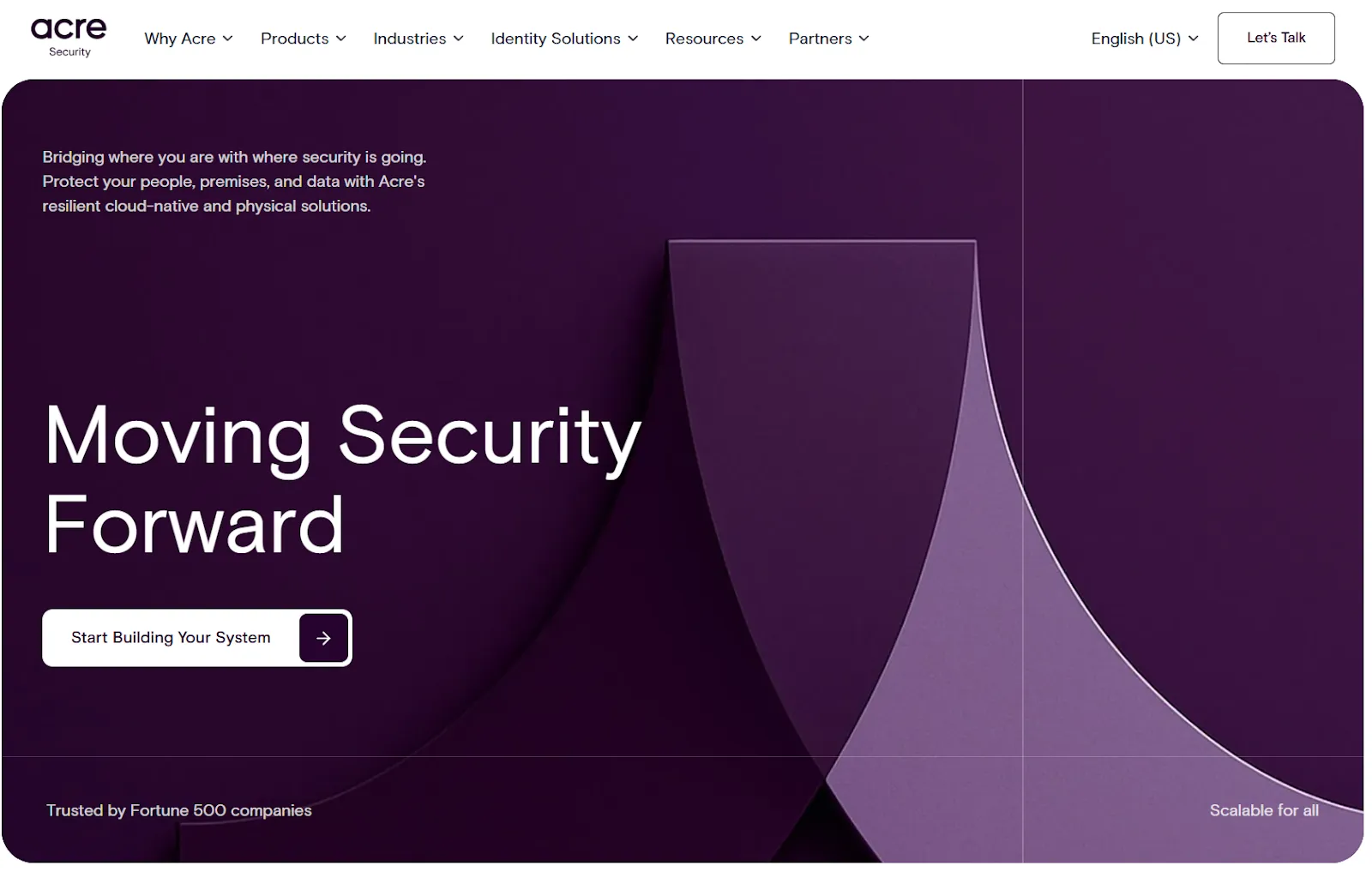
Acre Security is a unified physical security company offering a portfolio that spans cloud and on-prem access control, enterprise visitor management, intrusion detection, and secure networking. Trusted by Fortune 500 companies and global institutions alike — including Google, Pinterest, The Ritz London, Rockhurst University, and Dublin Airport Authority — Acre is built around one principle: give organizations the freedom to modernize on their own terms, without being forced into a proprietary ecosystem or a rip-and-replace migration.
Where most security vendors make you choose between capability and flexibility, Acre delivers both. Their solutions deploy cloud, on-prem, or hybrid, and integrate across identity providers, video management systems, workplace platforms, and physical infrastructure — including existing cameras and legacy hardware you already own.
Before diving deeper into the Genetec vs Verkada comparison, it’s worth understanding why Acre belongs in this evaluation. Acre’s platform was designed from the ground up to solve the exact problems that make enterprises outgrow both Genetec and Verkada — complexity on one side, lock-in on the other.
The result is a security platform that scales with your organisation without holding it hostage.
Open Architecture, Real Integration Depth
The word enterprises use most when describing Acre is freedom. Freedom to retain existing infrastructure. Freedom to migrate to the cloud at your own pace. Freedom to integrate hardware and software from multiple vendors without a penalty. For multi site businesses managing access control, video surveillance, and compliance across complex environments, that freedom has measurable operational and financial value.
Acre doesn't lock you into a proprietary ecosystem. Their open architecture supports hybrid deployment options — cloud, on-prem, or both — giving security and IT teams more control over how data is stored, processed, and accessed. This directly addresses one of the most common objections enterprises raise when evaluating cloud-based security platforms: data sovereignty.
When cloud security raises concerns, Acre's answer is straightforward. Cloud, on-prem, and hybrid deployments are all supported. GDPR-aligned visitor data controls, configurable retention settings, and ISO 27001 information security certification are built into the platform — not bolted on. For regulated environments, air-gapped access control deployments are supported alongside cloud visitor management or monitoring layers for agility where it's appropriate.
Acre Access Control: Cloud, On-Prem, or Hybrid — Your Choice
Acre's access control system portfolio covers the full deployment spectrum. Acre Access Control is the cloud-native enterprise platform, built for multi-site administration, real-time alerts, analytics dashboards, mobile and biometric credentials, and deep integrations across identity providers, workplace platforms, and video management systems.
For organizations requiring cloud management with remote deployment and open API access to time and attendance systems, ACT365 delivers centralized door and user management, fire muster workflows, and scalability from single sites to distributed portfolios without the overhead of an on-premise server.
For customers who need local, sovereign, or air-gapped control, ACTpro is the on-prem controller-based system — proven at large door counts, in heritage buildings, and in government estates where cloud connectivity is restricted or prohibited.
For SMBs protecting critical doors without enterprise overhead, the Smart Controller is a cost-optimized hardware controller that natively connects to Acre's cloud platform. Launched in September 2025, it brings enterprise-grade cloud access control to smaller sites at a new price point — enabling organizations to start small, prove value, and expand without re-architecting their security stack.
Security teams get full visibility into who is accessing what, when, and from which location — across every site, from one dashboard.
Enterprise Visitor Management: Security Starts at the Front Door
Visitor management is no longer just a sign-in sheet. Acre's Enterprise Visitor Management platform is a cloud-based system for secure, seamless reception and compliance across single and multi-site portfolios. Pre-registration with branded digital invites, self-service kiosk and tablet check-in, QR badge activation for speed-lane access, host notifications, real-time reporting, and GDPR-aligned data controls are all standard.
Integrations with Outlook, Teams, Google Workspace, ChromeOS, and 125+ workplace tools mean visitor management fits into existing workflows rather than creating new ones. The platform supports customizable flows by visitor type — contractors, VIPs, event groups — with badge printing, optional access card issuance, and a Virtual Receptionist option for after-hours or low-touch lobbies.
For enterprise security and facilities teams, visitor management is also an experience management tool. Every interaction at reception is a brand moment and a compliance control point. Acre's platform handles both. See why we are ranked among the top visitor management softwares.
Acre Intrusion: From Panels to Platforms
Acre's intrusion detection platform — built around the SPCevo panel family and advanced Two-Way Wireless detectors — is designed for commercial and high-security environments where reliability and remote management are non-negotiable. The SPC Connect cloud portal gives installers and service providers remote visibility to monitor, maintain, and configure panels without a truck roll. SPCManager tiered licenses handle multi-panel deployments at scale.
For enterprises concerned about false alarms and maintenance overhead, modern intrusion panels paired with advanced wireless motion detectors and event verification workflows address both problems directly. Automated alarm response, integration with video management systems like Milestone and OnGuard, and remote firmware and health monitoring reduce noise and simplify ongoing operations.
The AIC-1200, announced in November 2024, represents the latest generation of modernized intrusion hardware — pairing a redesigned control panel with advanced wireless detectors for comprehensive, easier-to-manage protection.
Comnet by Acre: The Network Infrastructure Your Security Stack Needs
Physical security is only as reliable as the network it runs on. Comnet by Acre provides industrial-grade Ethernet switches, media converters, network extenders, and edge computing and video storage appliances engineered for mission-critical security deployments. Razberi Core M-Series servers and ServerSwitchIQ hybrid appliances consolidate management, recording, and PoE switching into purpose-built hardware, while Razberi Monitor delivers on-prem and cloud-based health, performance, and firmware management across distributed sites.
For transportation, energy, manufacturing, and campus environments — any deployment where cameras, controllers, and IoT devices run across complex physical infrastructure — Comnet's TAA/NDAA-compliant switches with lifetime warranties reduce both risk and operating cost.
Acre Identity: Unify Access, Compliance, and Visibility
Acre Identity, powered by the TDS Suite, sits above access control to unify how people are welcomed, verified, credentialed, and protected across complex multi-site environments. It bridges access control and visitor management with workflow automation, compliance management, and a consistent experience layer — covering employee onboarding, contractor verification, evacuation and life safety, and enterprise hospitality flows.
For enterprises managing compliance obligations across multiple locations, having video surveillance, access control, and life safety operating in a coordinated, auditable system is a meaningful operational and regulatory advantage.
Migration Without Disruption: Start Small, Scale Without Limits
One of the most common barriers to modernization is disruption risk. Acre eliminates that barrier with a pilot-first, scale-later approach. Migration tools are built to work with existing cameras, existing access control infrastructure, and existing workflows. You don't have to replace what's working to move forward.
This matters especially for multi site organizations managing different generations of hardware across locations. Acre's platform unifies it all — bringing centralized management to environments that previously required juggling multiple disconnected systems. Integrators commonly run proof-of-concept pilots — a single-door or four-week trial — before broader rollouts. Remote pre-configuration and deployment reduce site downtime, and standardized templates accelerate replication across locations.
Acre plays well with the stack you already own. Open APIs enable integration with time and attendance systems, HR platforms, PSIM, VMS, turnstiles, and intercoms on day one — so organizations can integrate what works and retire what doesn't, on their own timeline.
What Is Genetec?
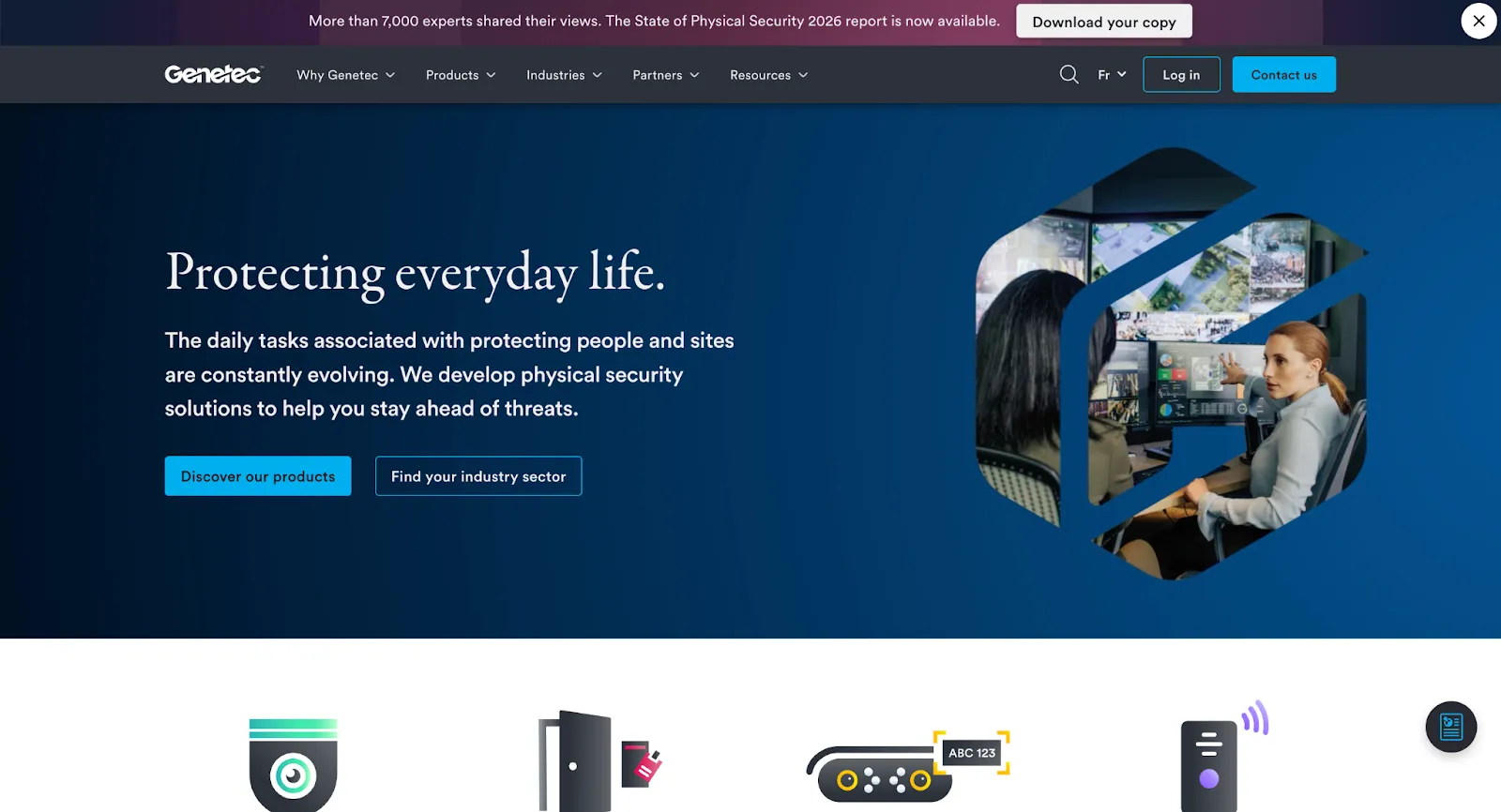
Genetec is a Montreal-based global technology company with over 25 years in the physical security industry. Their flagship product, Security Center, is an open-architecture platform that unifies video surveillance, access control, license plate recognition, intrusion monitoring, and analytics into a single system. Genetec serves enterprises, governments, and public safety organizations across 159 countries through a certified channel partner network.
In 2024, Genetec launched Security Center SaaS — their cloud-based evolution of Security Center — offering hybrid deployment options for organizations looking to move toward cloud without abandoning existing on-prem infrastructure. When asking who are Genetec's competitors, the list includes Avigilon, Axis, Milestone, Eagle Eye Networks, Verkada, and Acre Security.
What Genetec Gets Right
Genetec's open architecture is a genuine strength. Unlike fully proprietary platforms, Genetec supports third party integrations with a broad range of IP camera manufacturers, door controllers, and environmental sensors. Their investigation tools — including natural language video search, trajectory analysis, license plate recognition, and case and evidence management — are well-regarded for large-scale, complex security operations.
For government agencies, transportation hubs, airports, and smart city deployments where surveillance spans thousands of cameras across multi site infrastructure, Genetec's depth of functionality is hard to match.
Is Genetec a good company in terms of raw capability and industry pedigree? Yes. But capability alone doesn't determine fit — especially for organizations that don't have the resources to deploy and sustain a Genetec environment.
Here's Where Genetec Falls Short
The cost compounds fast. Genetec carries high licensing fees, and third party integrations can push costs significantly higher at enterprise scale. The licensing structure becomes a serious budget conversation before deployment even begins.
Requires Specialist Expertise to Operate
Genetec is not a plug and play system. Deployments require certified integrators, specialist training, and sustained technical management. For organizations without a large, dedicated IT security team, the burden of operating Genetec can outweigh the benefit of its capabilities.
Complex Deployments and Interface Friction
Large-scale Genetec deployments can become multi-year, multi-integrator projects. The interface, while powerful, is widely reported as complex — and interface friction has real consequences in security operations where response speed matters.
If these cons are important to you, uncover alternative Genetec options here.
Bottom Line: Built for Large Enterprises with Deep IT Resources
Genetec is built for government agencies, large public safety operations, and enterprises with deep integrator relationships and in-house IT security teams. If that profile doesn't describe your organization, the complexity-to-value tradeoff may not work in your favor.
What Is Verkada?

Verkada is a San Mateo-based physical security company founded in 2016. Their platform, Verkada Command, is a cloud based management system that unifies video surveillance, access control, alarms, intercoms, air quality sensors, environmental sensors, and workplace tools into a single interface. Verkada markets heavily to organizations looking for a simple, plug and play experience with minimal setup complexity.
Does Verkada work with Genetec? In limited contexts, some integrations exist. But Verkada's proprietary hardware ecosystem is fundamentally designed to operate within Verkada's own system — not alongside competing platforms. In the Genetec vs Verkada matchup, integration compatibility is one of the most significant points of divergence.
What is the alternative to Verkada? Eagle Eye Networks is one commonly cited alternative in the cloud video surveillance space. Genetec and Milestone are named by enterprise buyers. Acre Security is increasingly chosen by organizations specifically looking to escape proprietary lock-in — keeping their existing cameras while gaining cloud-native management, open integrations, and hybrid deployment options.
What Verkada Gets Right
Verkada delivers on ease of use. The Command platform is intuitive, cameras are online in minutes without local server configuration or port forwarding, and AI features — including facial authentication, natural language footage search, people counting, and environmental sensors — are well-implemented. For organizations that want to be operational quickly without complex infrastructure or extensive training, Verkada delivers a genuinely simple onboarding experience.
Their hybrid cloud model — data stored on device and in the cloud — reduces reliance on port forwarding and traditional NVR setups, simplifying deployment for IT teams managing cameras across distributed locations. Verkada is well-suited for organizations that want to start small and scale without building out on-prem server infrastructure.
Where Verkada Falls Short
The subscription trap is real. Every device on the Verkada platform requires an annual license starting around $199 per device per year. Let subscriptions lapse and functionality is severely restricted. Organizations don't own their security infrastructure — they're renting it, piece by piece, indefinitely. Verkada often has a higher total cost of ownership over time due to ongoing license renewals, even though it reduces upfront capital expenditure.
See different Verkada alternatives here.
FTC Scandal and a Troubled Privacy Record
Verkada's privacy and security track record demands scrutiny. In 2021, a major breach allowed unauthorized access to live video feeds from cameras across tens of thousands of organizations. In 2024, the FTC penalized Verkada for failing to protect customer data and for misleading security practices. For enterprises with compliance obligations in healthcare, financial services, or government, this history is a material consideration before any purchase decision.
Cloud Dependency Creates Operational Risk
Verkada's cloud native architecture is a deployment strength — but it creates a real operational vulnerability. Internet outages can cause cameras to experience latency or loss of functionality. Security threats don't pause for network disruptions. For enterprises managing critical sites, internet-dependent video surveillance carries risk that hybrid deployment options eliminate.
A Closed Ecosystem That Locks You In
Verkada's proprietary hardware ecosystem closes off options from day one. Existing cameras, door hardware, and access control devices that aren't Verkada-branded don't integrate cleanly. The more you invest in the platform, the harder and more expensive it becomes to change course. Businesses that prefer security solutions compatible with their existing cameras and existing infrastructure will find Verkada's closed ecosystem a persistent constraint.
Bandwidth and Feature Ceiling at Scale
Bandwidth-intensive continuous cloud streaming is also a real concern for large deployments or bandwidth-constrained environments. And advanced features and granular policy controls that are standard in traditional on-prem or open systems are often limited in Verkada's cloud interface — a ceiling that enterprise organizations will hit as their operations grow more complex.
Bottom Line: Built for SMBs, Not Enterprise
Verkada is built for SMBs and mid-market businesses that prioritize speed of setup over long-term strategic flexibility, and are comfortable betting on a single vendor's roadmap and pricing decisions for the life of the deployment. For enterprises with multi site complexity, compliance requirements, or mixed hardware environments, Verkada's constraints become structural problems.
Genetec vs. Verkada vs. Acre: Side-by-Side
The Verdict: Why Open Architecture Always Wins
Here’s why we say open architecture always wins.
On the Genetec vs Verkada Question
Both platforms represent well-funded, capable companies with real deployments at scale. But in the Genetec vs Verkada comparison, capability isn't the only variable enterprises should evaluate. Genetec is powerful but expensive, complex, and resource-intensive. It's built for organizations with deep integrator relationships and large, dedicated IT security teams. For everyone else, the complexity cost is real. Verkada is easy — but it's a strategic trap. Proprietary hardware, mandatory per-device licensing, documented FTC privacy issues, and internet-dependent operations make it a platform that works well until it doesn't.
Why Acre Security Belongs in This Conversation
Acre Security is the platform built for organizations that want enterprise-grade capability without the compromises. Open architecture. Cloud native flexibility. Genuine hardware agnosticism — including support for your existing cameras and infrastructure. Hybrid deployment options for regulated, heritage, or air-gapped environments. A pilot-first migration path that meets organizations where they are rather than demanding an immediate rip-and-replace commitment.
For multi site businesses managing video surveillance, access control, and intrusion detection across complex operations — and facing real questions about data sovereignty, vendor lock-in, migration risk, and total cost of ownership — Acre's platform addresses each one directly. Not with marketing language, but with architecture and deployment models designed around how enterprise security actually works. That's why organizations as varied as Google, Pinterest, Dublin Airport Authority, and a global media company managing 150+ sites have chosen Acre — not because it was the simplest option, but because it was the right one.
The security system conversation has changed. Organizations are no longer willing to accept proprietary lock-in, opaque pricing, or cloud-only architectures that introduce new vulnerabilities while solving old ones. Acre Security was built for exactly this moment.
Ready to See What Acre Looks Like in Practice?
Book a demo. Bring your current infrastructure details, your compliance requirements, and your questions about migration. An Acre specialist will build a path forward based on your actual environment — not a pre-packaged demo scenario.
No lock-in. No surprises. Security that moves with your business.
.jpg)
.webp)
.webp)