
Physical Access Control: How to Secure Every Entry Point Across Your Organization With Acre
.webp)
Most organizations don't discover the gaps in their physical access control until something goes wrong. A contractor badge that was never deactivated. A door with no entry log. An audit request that turns into a manual data collection exercise. An employee with access to a server room they had no reason to enter.
Physical access control governs who can enter, exit, or remain in any given area of your facility — and when. Done well, it protects your people, your assets, and your compliance posture. Done poorly, it creates exactly the kind of security gaps that regulators, insurers, and security teams spend months trying to close.
This guide covers the core types of physical access control systems, what a physical access control policy needs to include, and how Acre Security helps organizations deploy, manage, and enforce access control at every level — from a single critical door to a global estate of hundreds of sites.
Note: If managing physical access control across multiple sites, rotating workforces, or regulated environments is creating operational overhead or compliance risk, talk to the Acre team to discuss the right deployment for your organization.
When Physical Access Control Fails, the Costs Are Real
Physical security breaches are rarely dramatic. More often, they're the result of stale access permissions, manual processes that weren't followed, or legacy access control systems that couldn't integrate with the rest of the security stack. The consequences are consistent: unauthorized entry to sensitive areas, compliance violations, data exposure, and incidents that require expensive post-event investigation.
Security teams managing physical access control across multiple sites face a specific challenge: the more locations, users, and access points involved, the harder it becomes to enforce a consistent physical access control policy without a centralized, scalable platform. Organizations that are still managing physical access through disconnected systems, spreadsheets, or site-by-site configurations typically find that their access control operations don't scale — and their audit trail doesn't hold up.
Acre Security is built for exactly that challenge.
How Acre Deploys Physical Access Control Across Every Environment
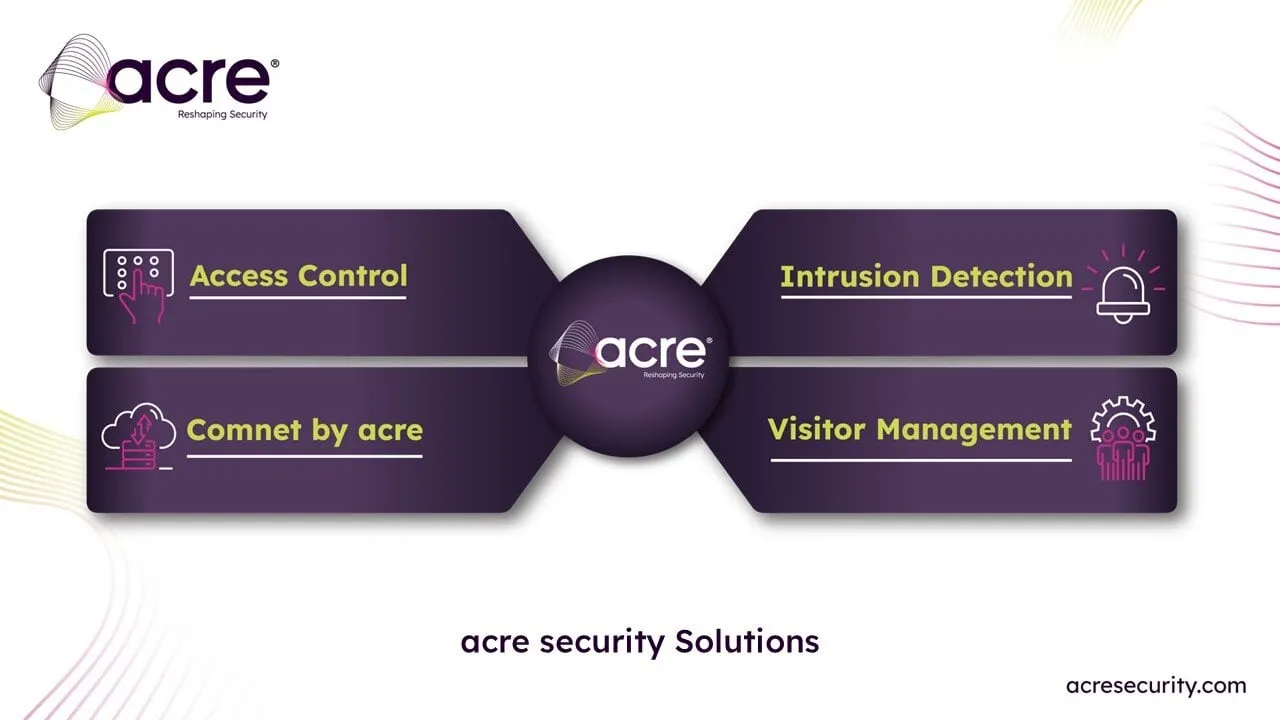
Acre Security offers a full portfolio of physical access control systems for organizations at every scale — from an SMB protecting a handful of critical doors to a global enterprise managing hundreds of sites across multiple continents.
Acre does not offer one access control system and ask you to make it fit. The portfolio covers cloud, on-premises, and hybrid deployments, giving organizations the architecture that matches their specific physical security requirements rather than the one their vendor prefers to sell.
Acre Access Control — Cloud-Native Physical Security at Enterprise Scale
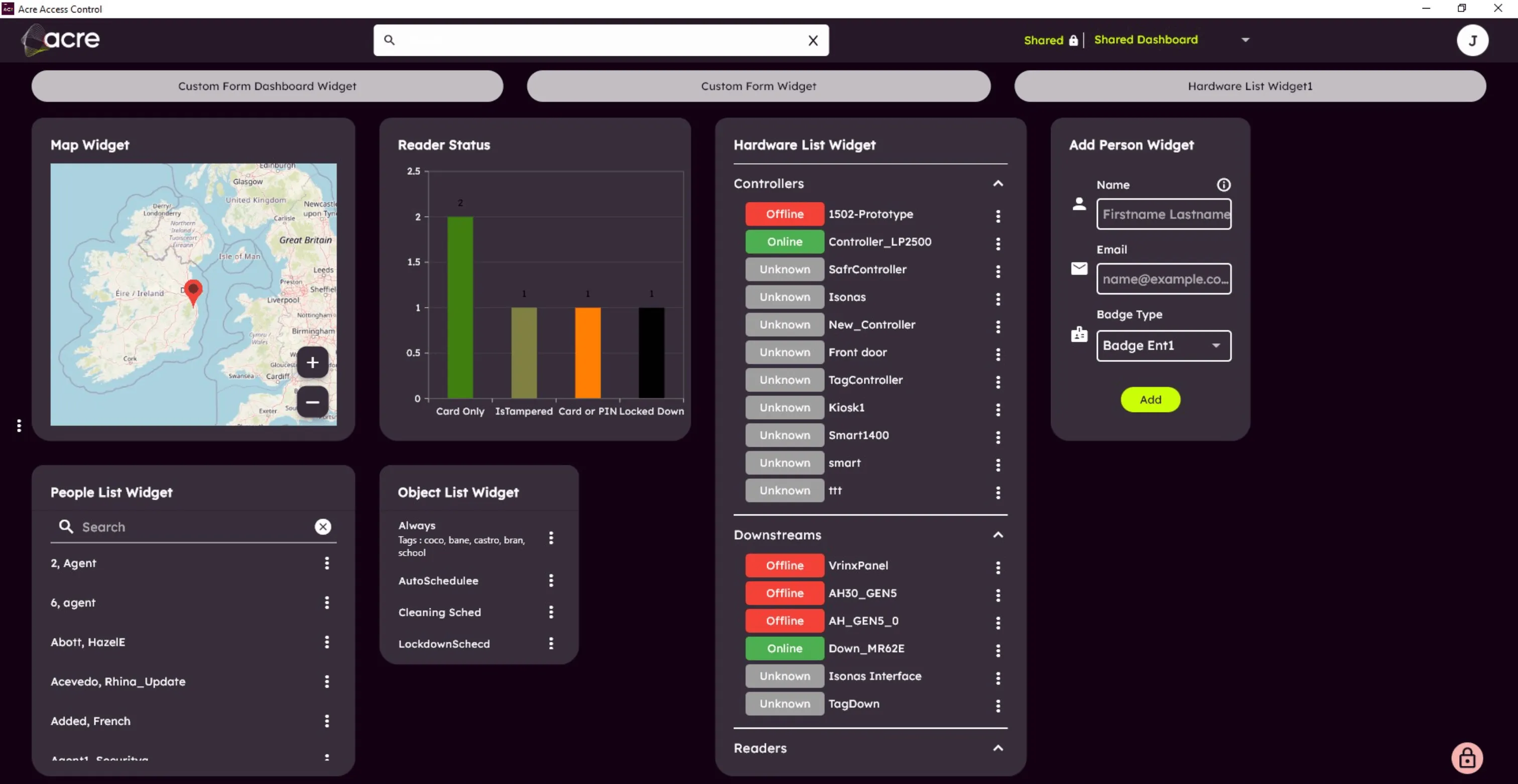
Acre Security Access Control is Acre's flagship cloud-native platform, designed for enterprises that need to manage physical access control across multiple sites from a single access control dashboard. It delivers real-time alerts, analytics dashboards, mobile and biometric access support, and a broad ecosystem of integrations with identity, workplace, and video management systems. Organizations including Google and Pinterest rely on Acre for their physical access control — a reflection of the platform's ability to operate at the highest levels of security demand and compliance.
ACTpro — On-Premises Physical Access Control for Regulated Environments
For organizations in government, heritage, or highly regulated sectors where data sovereignty and network isolation are non-negotiable, ACTpro delivers controller-based on-premises access control with full wired and Aperio wireless lock support. ACTpro is proven at large door counts and supports a broad range of reader and credential options, making it the right physical access control system for environments where cloud connectivity is restricted or where an air-gapped estate is required by policy.
ACT365 — Cloud-Managed Access Control for Distributed and Industrial Sites
ACT365 is built for organizations managing physical access control across multiple buildings, distributed workforces, or contractor-heavy operations. It supports remote configuration and deployment, open API integration with time and attendance systems, fire muster workflows, and unlimited door scaling by design. The Dublin Airport Authority is among the organizations that have trusted Acre Security for complex, high-volume physical access control deployments.
Smart Controller — Enterprise Cloud Access Control for Critical Doors
Launched in September 2025, the Smart Controller brings enterprise-grade cloud access control to organizations protecting a smaller number of critical doors — server rooms, executive suites, warehouse access points, front entrances. It connects natively to Acre's cloud platform, enabling remote management, automatic updates, and multi-site scale without a large-scale hardware deployment. It is the right access control system for SMBs that want enterprise physical security capability without enterprise infrastructure overhead.
Enterprise Visitor Management — Extending Physical Access Control Beyond Credentialed Users
Acre's Enterprise Visitor Management system extends physical access control to every person who enters your building — not just employees. With digital invitations, self-service check-in on kiosks or tablets, QR scanning, and integration with Outlook, Teams, Google, and 125+ workplace tools, EVM ensures that visitor management is a controlled, auditable process that sits inside — not alongside — your physical access control policy. The Ritz London and Rockhurst University are among the organizations that use Acre's visitor management capabilities to secure their physical environments. Learn more about Acre's systems for visitor management here.
Integrating Physical Access Control With Your Wider Security Stack
Physical access control does not operate in isolation. The most effective physical security programs integrate access control systems with video surveillance, intrusion detection, visitor management systems, and identity platforms to create a unified operational picture.
Acre Access Control is built for integration across other security systems. It connects with video management systems, PSIM platforms, HR and identity providers, and workplace tools — giving security teams a single view of access events rather than a fragmented set of disconnected systems. Acre Intrusion (SPCevo) can be paired with access control to enable unified alarm and access workflows: when an intrusion event is detected, access control responses are triggered automatically, reducing response time for security personnel and limiting the window of exposure.

Acre Identity, powered by TDS Suite, sits above the access control layer to unify how employees, contractors, and visitors are welcomed, verified, credentialed, and protected across multi-site environments — bridging physical access control systems and visitor management with workflow automation and compliance management.
Physical Access Control in Regulated Industries
Organizations in healthcare, education, government, finance, and critical infrastructure face specific compliance requirements that their physical access control policy must support. Physical security in these sectors is not just an operational concern — it is a regulatory one.
Acre's cloud access control platform is aligned to GDPR data protection requirements and supports SOC 2 compliance for cloud deployments. ISO 27001 certification applies to specific parts of Acre's portfolio — organizations in regulated sectors should verify scope for their specific deployment. For government and critical infrastructure environments, Acre's hybrid and on-premises deployment options — including ACTpro for air-gapped estates — provide the physical access control security posture required for sensitive environments.
Logical access control and physical access control are increasingly converging in regulated environments, where identity and credentialing systems need to manage both digital and physical entry points through a consistent framework. Acre Identity addresses this convergence by providing a platform layer that bridges physical access control with broader identity governance — ensuring that the same standards applied to digital access are applied to who enters your buildings.
Choosing the Right Physical Access Control System for Your Organization
The right physical access control system depends on your deployment environment, compliance obligations, workforce composition, and integration requirements. The key variables to consider include the number of sites and access points, whether cloud, on-premises, or hybrid architecture is required, the mix of permanent employees, contractors, and visitors your access control policy needs to cover, and the level of audit trail detail your compliance framework demands.
Acre's portfolio is designed to answer each of these scenarios without requiring organizations to compromise on capability or security. Whether you need a cloud-native enterprise platform, an on-premises system for a regulated site, or a cost-optimized controller for a small number of critical doors, Acre has a physical access control system built for your environment.
Want to understand the total cost of your current physical access control setup? Use the Acre TCO Calculator to compare your current costs against a modern, cloud-managed access control platform.

The Types of Physical Access Control Systems — and What Each One Requires to Work
Physical access control covers a wide range of technologies and models. Understanding each type helps, but the more important question is whether your platform can enforce and manage these models consistently across your entire estate. Here is how the main types compare, and where Acre fits each scenario.
Discretionary Access Control (DAC)
In a DAC model, administrators assign and adjust access rights at their discretion. It is flexible and quick to configure, but it relies on individual administrators making consistent access decisions — which creates security gaps at scale. Without a centralized access control dashboard, DAC environments accumulate stale access permissions and inconsistently enforced access rules over time.
Mandatory Access Control (MAC)
MAC enforces access based on fixed classifications, typically used in government facilities, military environments, and highly regulated sectors where access decisions cannot be delegated to individual administrators. Access is centrally governed, users cannot modify their own access permissions, and authorized personnel are clearly defined by classification. This model requires a robust, auditable platform to maintain consistently.
Role-Based Access Control (RBAC)
RBAC is the most common model in enterprise physical security. Access permissions are tied to roles rather than individuals — so an IT manager, a facilities team member, and a contractor each receive the access that corresponds to their function. Role-based access reduces over-permissioning, simplifies access administration, and improves audit trails significantly. Acre Access Control supports RBAC natively, allowing security teams to define roles, set access levels, and manage changes centrally across multiple sites from a single interface.
Rule-Based Access Control
Rule-based access control layers conditional logic over role definitions. A contractor may only gain access during business hours; a visitor may only be granted access to specific areas after completing a check-in workflow. Temporary access for maintenance crews, external vendors, or time-limited projects falls under this model. Rule-based access is typically deployed alongside RBAC to handle context-specific and time-bounded scenarios without creating permanent access permissions.
Biometric Access Control
Biometric systems verify a user's identity using physical characteristics — fingerprints, facial recognition, or iris scans. Unlike key cards or PINs, biometric credentials cannot be lost, shared, or transferred, making them well-suited for sensitive areas that require heightened security and reliable identity verification. Acre Access Control supports mobile and biometric access options, and Acre Wallet delivers secure mobile credentials protected by Face ID or fingerprint authentication — replacing physical credentials without compromising security.
Card-Based Access Control and Mobile Credentials
Key cards and key fobs remain the most widely deployed physical credentials across commercial real estate, education, and corporate environments. They are familiar, cost-effective, and easy to manage at scale — provided your system can handle deactivation and re-issuance efficiently. Increasingly, organizations are replacing physical credentials with mobile credentials. Acre Wallet uses BLE and NFC to deliver access from a smartphone, reducing the operational overhead of physical card management while maintaining strong identity verification at every entry point.
Keypad and PIN-Based Access Control
Basic keypads are appropriate for lower-risk access points where simplicity and cost efficiency take priority. PIN-based access control is best used in combination with other verification methods or in areas where the consequences of unauthorized entry are limited. For most regulated environments and sensitive areas, keypad entry alone does not satisfy modern physical access control policy requirements.
What a Physical Access Control Policy Needs to Cover
A physical access control policy is the governance framework that defines how your organization manages entry, credentials, access permissions, and auditing. The technology you deploy only works as well as the policy it enforces. Organizations that invest in access control systems without a clearly defined physical access control policy often find that their platform is under-configured, inconsistently applied, and unable to meet compliance requirements when it matters.
A well-designed physical access control policy should address several core areas — each of which maps directly to capabilities in Acre's platform.
Access Levels and Role Definitions
Your physical access control policy should define who can access which areas, under what conditions, and with what level of authorization. This means mapping roles to access levels — employees, contractors, visitors, security personnel — and enforcing the principle of least privilege: each person should have access to only the physical space and areas required for their specific role, and for no longer than necessary. Acre Access Control's RBAC capabilities allow security teams to enforce this aspect of physical access control policy consistently across unlimited sites without manual reconfiguration at each location.
Temporary Access and Contractor Management
Managing temporary access is one of the most common failure points in physical access control policy. Contractor badges that aren't deactivated at the end of a project, visitor access that outlasts the visit, emergency credentials that were never revoked — these are the access control gaps that create real exposure. Your physical access control policy should define the full lifecycle of every temporary credential: how it is issued, what access is granted, and when it expires automatically. ACT365 is specifically designed for contractor-heavy and distributed environments, supporting time-bounded access, remote workforce management, and fire muster workflows across multiple sites.
Audit Trails and Compliance Requirements
Any physical access control policy built for a regulated environment needs to specify how access events are logged, retained, and reported. Audit logs are not just a compliance requirement — they are the primary tool for post-incident investigation and access review. Acre Access Control generates real-time access event data, supports analytics dashboards for ongoing access review, and produces the auditable records that compliance frameworks such as GDPR and SOC 2 require. ISO 27001 certification applies to specific parts of Acre's portfolio — verify the scope relevant to your deployment.
Visitor Management Integration
A physical access control policy that governs employees but not visitors has a significant gap at every entry point. Acre's Enterprise Visitor Management system integrates directly with your physical access control systems to bring visitors into the same policy framework as credentialed staff — with digital pre-registration, self-service check-in, QR-based access grants, and auditable visit logs. Every person who enters your facility, regardless of their status, is captured within the physical access control policy rather than managed through a separate, disconnected process.
FAQs: Physical Access Control
What is physical access control?
Physical access control refers to the systems, technologies, and policies that manage who can enter or exit a building, room, or secure area. Physical access control systems range from key cards and basic keypads to cloud-managed platforms with biometric access, real-time alerts, and multi-site administration.
What is a physical access control policy?
A physical access control policy is the governance framework that defines how an organization manages access permissions, credentials, audit trails, temporary access, and visitor management. A well-designed physical access control policy specifies access levels by role, lifecycle management for temporary credentials, and the audit and reporting requirements needed for regulatory compliance.
What is the difference between physical and logical access control?
Physical access control governs entry to physical spaces — buildings, rooms, secure areas. Logical access control governs access to digital systems and data. In modern security environments, these two domains are increasingly integrated, with unified identity platforms managing both physical and logical access through a single framework.
What types of physical access control systems does Acre offer?
Acre offers cloud-native enterprise access control (Acre Access Control), cloud-managed access control for distributed and industrial sites (ACT365), on-premises controller-based access control (ACTpro), and the Smart Controller for enterprise-grade cloud access control at critical doors. All products integrate with Acre's Enterprise Visitor Management system and the wider Acre portfolio including acre Intrusion and Acre Identity.
How does physical access control support compliance?
Physical access control systems support compliance by generating audit logs, enforcing role-based access permissions, and producing the records required for frameworks such as GDPR, SOC 2, and sector-specific regulations. Acre's cloud access control platform is aligned to GDPR and supports SOC 2 compliance. ISO 27001 certification applies to specific parts of Acre's portfolio — verify scope for your deployment.
Can physical access control integrate with video surveillance and intrusion detection?
Yes. Acre's access control platform integrates with video management systems and PSIM platforms, and acre Intrusion (SPCevo) can be configured to enable unified alarm and access workflows. This gives security teams a connected view of security events rather than isolated system outputs.
.jpg)