
ROI of Implementing a Visitor Management System: How to Build a Business Case That Gets Approved

The paper visitor log at your front desk looks free. It is not. Its costs sit in places no budget line captures: reception hours spent on manual tasks, hosts interrupted by phone calls, visitor records nobody can find during an audit, and a lobby with no reliable answer to who is in the building right now.
That is why the ROI of implementing a visitor management system is hard to argue from instinct and easy to argue from numbers. Finance will not fund "better security" as a line item. It will fund a business case that sets time saved, costs removed, and risk reduction against a known total cost.
This guide gives you that structure: where the return comes from, what the system costs, the formula to use, and what verified Acre customers report. Acre visitor management, delivered through Acre Identity by TDS, is built around the same levers, so each section shows how the platform supports the number you need to defend.
Note: If your business case still rests on estimates, Acre can help you replace them with figures from your own sites. You get a clear view of the time savings, total cost, and risk reduction that Acre Identity by TDS would deliver across your locations, mapped to the access control systems you already run. Talk to the Acre team to scope your visitor management ROI before your next budget review.
Why manual visitor processes cost more than they appear to
Manual processes spread their cost across three groups: front desk staff, hosts, and the visitors themselves. When visitors arrive, someone hands over a sign-in sheet, looks up the host, makes a call, and writes out a badge. During busy periods, that sequence becomes a queue. Manual visitor registration leads to longer wait times, and meetings start late as a result.
The second cost is record keeping. Paper logs have to be stored, retrieved, and deciphered. Handwriting introduces manual errors, and a missing page cannot be recovered. The third cost is exposure. An open sign-in sheet shows visitor data to every person who signs in next, which makes paper visitor logs a privacy risk and a potential source of data breaches. It also cannot tell you who is still on site during an evacuation.
None of this appears on an invoice. A credible business case starts by making these costs visible.
Where visitor management ROI comes from
Visitor management ROI comes from six sources. The first two are the easiest to quantify. The remaining four are harder to price, but they often decide budget approval because they address risk and reputation.
Time savings at the front desk
Automating visitor registration removes the repetitive tasks that fill a receptionist's day. With pre registration, the visitor's details are captured before arrival. At the self service kiosk, the visitor confirms their details, badge printing happens on the spot, and host notifications go out automatically. Nobody leaves the desk to track down a host.
The time saved per visitor check in is small. Multiplied across your monthly visitors, it becomes a figure finance recognizes. Automated check ins also return valuable time to hosts, who are no longer pulled away to collect guests who were not expected.
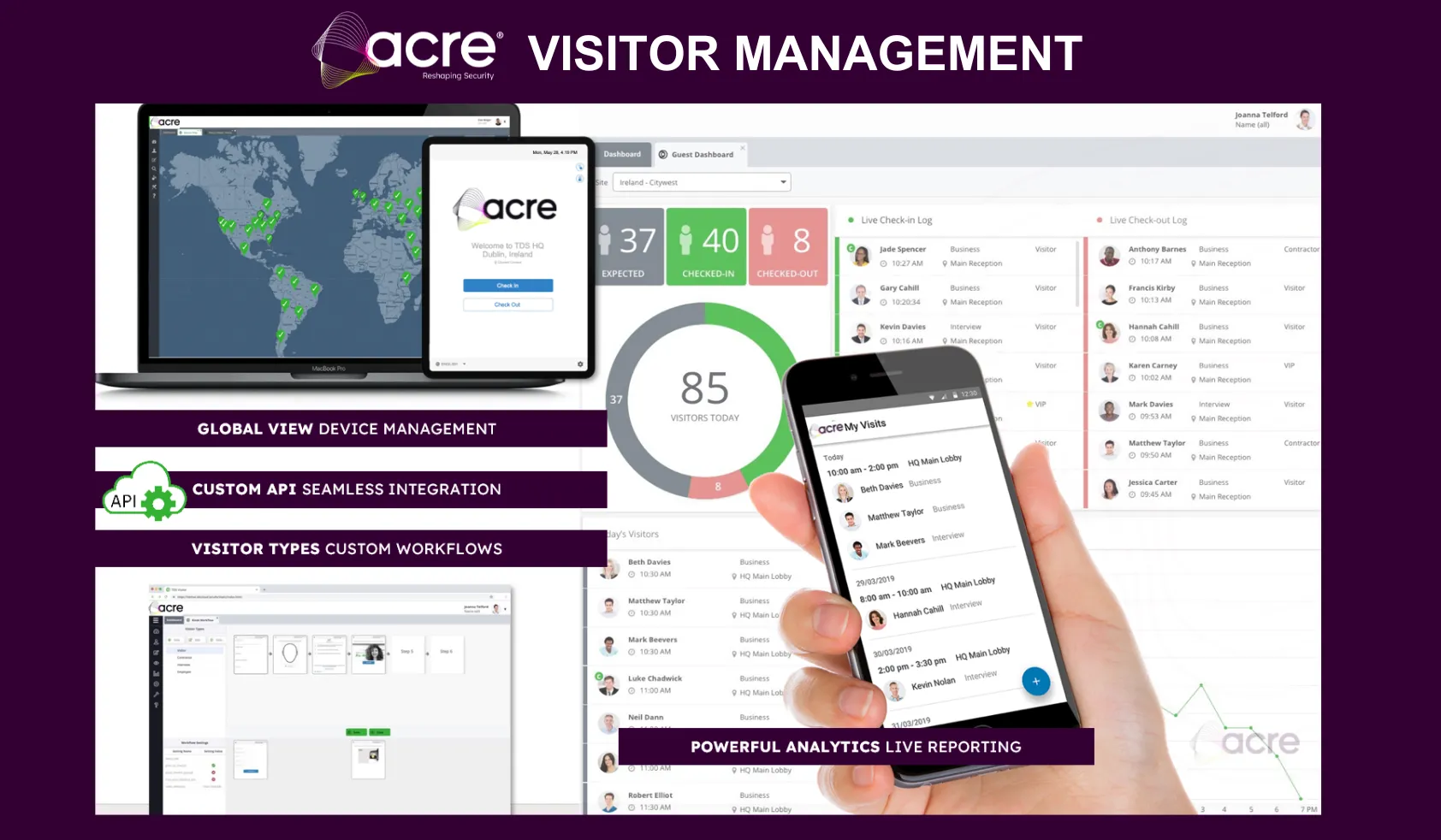
Acre Identity by TDS automates check-in, badge printing, and reporting to reduce admin time. Hosts receive notifications and approve visits from desktop or mobile apps, so the front desk is not the relay point for every arrival.
Lower costs from retiring paper logs
A visitor management system reduces manual work and the infrastructure that supports it. Digital logs remove the need for physical storage of visitor logs, along with logbooks, pre-printed passes, and the hours spent filing them.
Automating data collection also improves the quality of what you keep. Digital visitor records are complete, legible, and searchable. A request that once meant paging through binders becomes a filtered report. Acre Identity by TDS captures and stores check-in data, headcounts, and event history automatically, ready for audits, insurance, or incident reviews.
Risk reduction and regulatory compliance
For enterprises handling sensitive information, compliance with data protection laws is not optional. A paper visitor log is a weak point under regulations such as GDPR and CCPA. You cannot control who reads it, apply a retention period to it, or delete a single entry on request.
A visitor management system centralizes visitor registration, records actions in an audit trail, and applies retention rules without manual effort. That reduces compliance risk, because data collection and handling no longer depend on someone remembering to do it. It also shortens audit preparation. Automated reporting produces the evidence an auditor asks for, which is how digital systems simplify audits and help organizations avoid fines.
Acre builds privacy controls into visitor management: encryption, configurable data retention, and customer control over what is stored and for how long. Acre's information security management is backed by ISO 27001 certification. Compliance still depends on how your organization configures and operates the system, so confirm the scope for your jurisdiction before you put a figure on it.
Enhancing security and reducing incidents
A paper log records who a visitor claims to be. A visitor management system checks. ID verification at check-in confirms identity, and structured visitor controls reduce unauthorized access by defining who can enter, where, and for how long. With access control integration, a visitor badge opens only the doors that visit requires, so only authorized individuals move beyond the lobby.
Real-time tracking matters most when something goes wrong. Security teams can track visitors currently on site and respond to security incidents with accurate information. During an evacuation, a live digital headcount replaces a clipboard.
Enhancing security has a financial value, but price it carefully. Avoiding security breaches protects the organization from unexpected costs, but do not invent a probability for security breaches. Use the documented cost of past security incidents at your own sites, and present the figure as avoided exposure. Acre Identity by TDS supports these security measures with ID validation at the kiosk, watchlist screening, live dashboards, and real-time mustering for drills and evacuations.
Improved visitor experience
The lobby is a brand moment. A fast, well-run visitor check in tells a client, candidate, or auditor how the rest of the organization operates. Self-service check-in and instant host notifications mean guests are not left waiting, and meetings start on time. The visitor experience improves without adding reception staff.
An improved visitor experience is difficult to express in currency, so treat it as a qualitative benefit in your business case and describe the visitor experience you have today for contrast. Acre Identity by TDS supports the visitor experience with digital invites, branded kiosks and badges, and a Virtual Receptionist option for after-hours or low-touch lobbies.
Operational efficiency across multiple locations
Organizations with multiple locations often run a different visitor process at each one. A single visitor management system standardizes visitor processes, so security measures, guest check ins, and reporting work the same way at every site. That consistency is where operational efficiency improves. Multi location management from one dashboard also removes duplicated administration.
Visitor data adds a further return. Reports on visitor volume, peak arrival times, and visit types give facilities teams valuable insights for staffing the front desk and planning space. Acre Identity by TDS provides live dashboards showing who is checked in, where they are, and why, across all locations and visitor types.
Visitor management system cost: what to include
ROI is only as credible as the cost side of the equation. Setup costs generally include software subscriptions and hardware, but the total cost of a visitor management system reaches further. Build your estimate from five categories.
- Software. The visitor management software subscription. Pricing models vary by vendor, so confirm what drives the price: locations, kiosks, features, or visitor numbers.
- Hardware. Kiosks or tablets, a badge printer for each entry point, and mounts or stands.
- Implementation. Configuration, directory connections, and integration with existing systems such as access control systems and calendars.
- Employee training. Time for reception and security staff to learn the new process. Employee training is a real cost even when the software is simple.
- Ongoing operation. Badge printer consumables, support, and licenses for added locations.
Separate upfront costs from annual costs. Finance will want to see first-year spend and steady-state spend as two different numbers.
Then look for hidden costs. The most common is integration. If your visitor management software does not connect to the access control and workplace tools you already run, you pay for custom work or for replacing equipment that still functions. Other hidden costs include features reserved for higher tiers and per-location fees that grow as you expand.
Acre Identity by TDS connects with 125+ access control platforms and enterprise tools, without rip-and-replace. That keeps existing systems in service and removes one of the largest variables from the estimate. Acre pricing is not published. It varies by license tier and region and is sold through certified partners, so the Acre team can scope an accurate figure for your sites.
How to calculate the ROI of a visitor management system
Use a standard formula that finance already accepts, and fill it with your own data.
ROI (%) = (Total annual benefits - Total annual cost) ÷ Total annual cost × 100
Work through it in five steps.
- Establish total cost. Add upfront costs and annual costs for year one. Use annual costs alone for later years.
- Calculate annual time savings. Multiply monthly visitors by the minutes saved per check-in, then by 12. Divide by 60 to get hours, and multiply by the loaded hourly cost of front desk staff. To find minutes saved, time a sample of visitors on your current process and compare it with the vendor's process during a pilot.
- Add direct savings. Include paper logbooks, storage, and any legacy tools the new system retires.
- Estimate risk reduction. Count the hours your team spends on audit preparation and visitor record requests today. Add the documented cost of past security incidents, if you have them. Keep this as a separate line so reviewers can weigh it on its own.
- Run two scenarios. Present a conservative case using only steps two and three, and a full case that includes step four.
The table below lists each input and where to find it.

Published benchmarks for visitor management ROI vary widely and rarely match your visitor numbers or staffing model. Your own figures will stand up better under review. For a faster first estimate, use Acre's Visitor Management Value Calculator, then refine the result with data from a pilot.
What Acre customers report
A visitor management business case is stronger with evidence from comparable organizations. The two examples below come from Acre's published customer success stories.
Google: 300+ locations and more than 20 million visitor check-ins
Google engaged Acre in 2012 to deliver visitor management across its global estate. The requirement was specific: collect, store, and organize visitor information automatically, and reduce the administrative burden on front-of-house teams. Google also needed a back office for visitor data, historical records, analytics, and real-time monitoring, connected to its existing access control environment.
Acre deployed its TDS visitor management suite with self-service kiosks and access integration. For approved events, guests scan the QR code on their badge to move through authorized doors and turnstiles. Since 2012, Google has deployed Acre solutions in 300+ locations, with more than 20 million visitor check-ins. Reported benefits include increased operational efficiency, comprehensive reporting, third-party integration, and built-in GDPR compliance. Read more here.
Pinterest: cost savings after a four-week proof of concept
Pinterest needed a more efficient way to manage visitors at its San Francisco headquarters, with deep integration into access control and a more responsive vendor relationship than its previous provider offered. After on-site meetings and a four-week proof of concept, Pinterest selected Acre's cloud visitor management in early 2023 for a global rollout.
The visitor management system creates visitor profiles, tracks visitor information, issues digital badges, and connects to Pinterest's existing security systems. Acre reports that Pinterest is seeing cost savings and reduced administrative effort across its sites. The proof of concept is worth copying: a pilot at one location produces the measured inputs your formula needs. Learn more.
How Acre Identity by TDS supports each part of the business case
Each source of visitor management ROI in this guide maps to a specific platform capability. Use the table below when you write the solution section of your proposal.

Acre supports cloud, on-premises, and hybrid deployment. Organizations that keep access control on-premises for sovereignty reasons can still run visitor management in the cloud, which keeps the project within existing security policy.
Questions to answer before budget approval
Reviewers tend to ask the same questions. Prepare answers to these before the business case reaches the approval meeting.
- Which existing systems must the platform connect to on day one, and are those integrations included in the quote?
- Does the platform support single sign on for administrators and hosts?
- How is visitor data stored and retained, and who can change those settings?
- How will visitor management support our wider workplace security policy, operational efficiency targets, and business operations?
- What does expansion from one location to every site cost?
- What will a pilot measure, and what result justifies a full rollout?
Frequently asked questions
These are the questions security and facilities leaders raise most often when assessing return.
How quickly does a visitor management system pay for itself?
There is no universal figure. Payback depends on visitor numbers, staff costs, and the total cost of the visitor management system. Sites with heavy visitor traffic and staffed reception desks tend to recover the investment sooner, because time savings accumulate with every check-in.
Is an automated visitor management system worth it for one location?
It can be. A single site with steady visitor traffic, compliance obligations, or access-controlled areas gains from automated check-in, accurate records, and an audit trail. Run the formula with your own numbers to confirm.
Does a visitor management system replace front desk staff?
No. It removes manual tasks from the role. Staff spend less time on data entry and badge writing and more time on the guests and exceptions that need attention.
Put a number on your visitor management ROI
If your business case still rests on estimates, Acre can help you replace them with figures from your own sites. Talk to the Acre team to scope Acre Identity by TDS against your visitor numbers, locations, and existing access control systems.